
Brain, spinal cord, peripheral nerves and cranial nerves
Sensing. Thinking. Moving. Regulating. Connecting the whole body.
The nervous system is the body’s rapid communication and control network. It receives information from inside and outside the body, processes it, and coordinates responses ranging from conscious thought and movement to automatic functions such as heart rate, breathing, digestion and temperature regulation.
The Nervous System at a glance
The system is divided into two major parts
|
CENTRAL
NERVOUS SYSTEM (CNS) |
PERIPHERAL
NERVOUS SYSTEM (PNS) |
- In simple terms: the CNS interprets and coordinates, while the PNS carries information to and from it. Both systems operate continuously as one integrated network.
The Brain
The brain is the most complex organ in the body. Billions of nerve cells and supporting cells form networks that allow perception, attention, memory, language, emotion, decision-making, movement and conscious experience.
Main regions of the Brain
Cerebrum – The largest part of the brain. It supports conscious thought, perception, language, memory, voluntary movement and complex behaviour.
Frontal lobes – Important for planning, attention, inhibition, working memory, social behaviour, decision-making and voluntary movement.
Parietal lobes – Process touch and body sensation and help integrate spatial information and awareness of the body.
Temporal lobes – Important for hearing, language, memory and aspects of emotion and object recognition.
Occipital lobes – Primarily responsible for processing visual information.
Basal ganglia – Deep brain structures involved in movement, action selection, motivation, habit learning and reward-related processes.
Limbic networks – Interconnected regions involved in emotion, memory, motivation and responses to threat and reward.
Cerebellum – Coordinates movement, balance and motor learning, and also contributes to timing, cognition and some aspects of emotion.
Brainstem – Connects the brain with the spinal cord and helps control breathing, heart rate, wakefulness, swallowing and other essential functions.
3. The Spinal Cord
The spinal cord is a long column of nervous tissue running from the brainstem through the spinal canal. It carries sensory information towards the brain and motor commands from the brain to the body.
- Spinal nerves leave the cord in pairs and supply different regions of the trunk and limbs.
- The spinal cord can coordinate rapid reflexes without waiting for conscious processing in the brain.
- Damage to the cord can affect movement, sensation, bladder and bowel function, sexual function and autonomic regulation below the level of injury.
4. The Peripheral Nervous System
The peripheral nervous system includes the nerves and nerve clusters outside the brain and spinal cord. It is the communication link between the CNS and the rest of the body.
|
Sensory (afferent) pathways |
Motor (efferent) pathways |
|
Somatic nervous system |
Autonomic nervous system |
5. The Autonomic Nervous System
The autonomic nervous system helps maintain internal stability without requiring conscious control. It has interacting branches rather than a simple on/off switch.
Sympathetic system – Prepares the body for action. It can increase heart rate, redirect blood flow, widen the pupils and support rapid responses to challenge or threat.
Parasympathetic system – Supports rest, digestion and recovery and can slow the heart and promote digestive activity. The vagus nerve is an important parasympathetic pathway.
Enteric nervous system – A large network of nerve cells within the gastrointestinal tract that coordinates digestion and communicates extensively with the brain and autonomic nervous system.
6. The 12 Cranial Nerves
Most peripheral nerves leave the spinal cord, but the cranial nerves arise directly from the brain or brainstem. They control major sensory and motor functions of the head and neck, with the vagus nerve extending into the chest and abdomen.
|
No. / Nerve |
Type |
Main role |
Key point |
|
I Olfactory |
Sensory |
Smell |
|
|
II Optic |
Sensory |
Vision |
Retina to brain |
|
III Oculomotor |
Motor |
Most eye movements, eyelid elevation and pupil constriction |
Eye movement |
|
IV Trochlear |
Motor |
Moves the eye via the superior oblique muscle |
Eye movement |
|
V Trigeminal |
Both |
Facial sensation; chewing muscles |
Largest cranial nerve |
|
VI Abducens |
Motor |
Moves the eye outward |
Eye movement |
|
VII Facial |
Both |
Facial expression; taste from front of tongue; tears and saliva |
Facial movement |
|
VIII Vestibulocochlear |
Sensory |
Hearing and balance |
Ear/balance |
|
IX Glossopharyngeal |
Both |
Taste and sensation from back of tongue; swallowing; salivation |
|
|
X Vagus |
Both |
Swallowing and voice; parasympathetic control of heart, lungs and digestive tract; visceral sensation |
Major mind-body/autonomic pathway |
|
XI Accessory |
Motor |
Head turning and shoulder elevation |
|
|
XII Hypoglossal |
Motor |
Tongue movement |
|
7. How nerves communicate
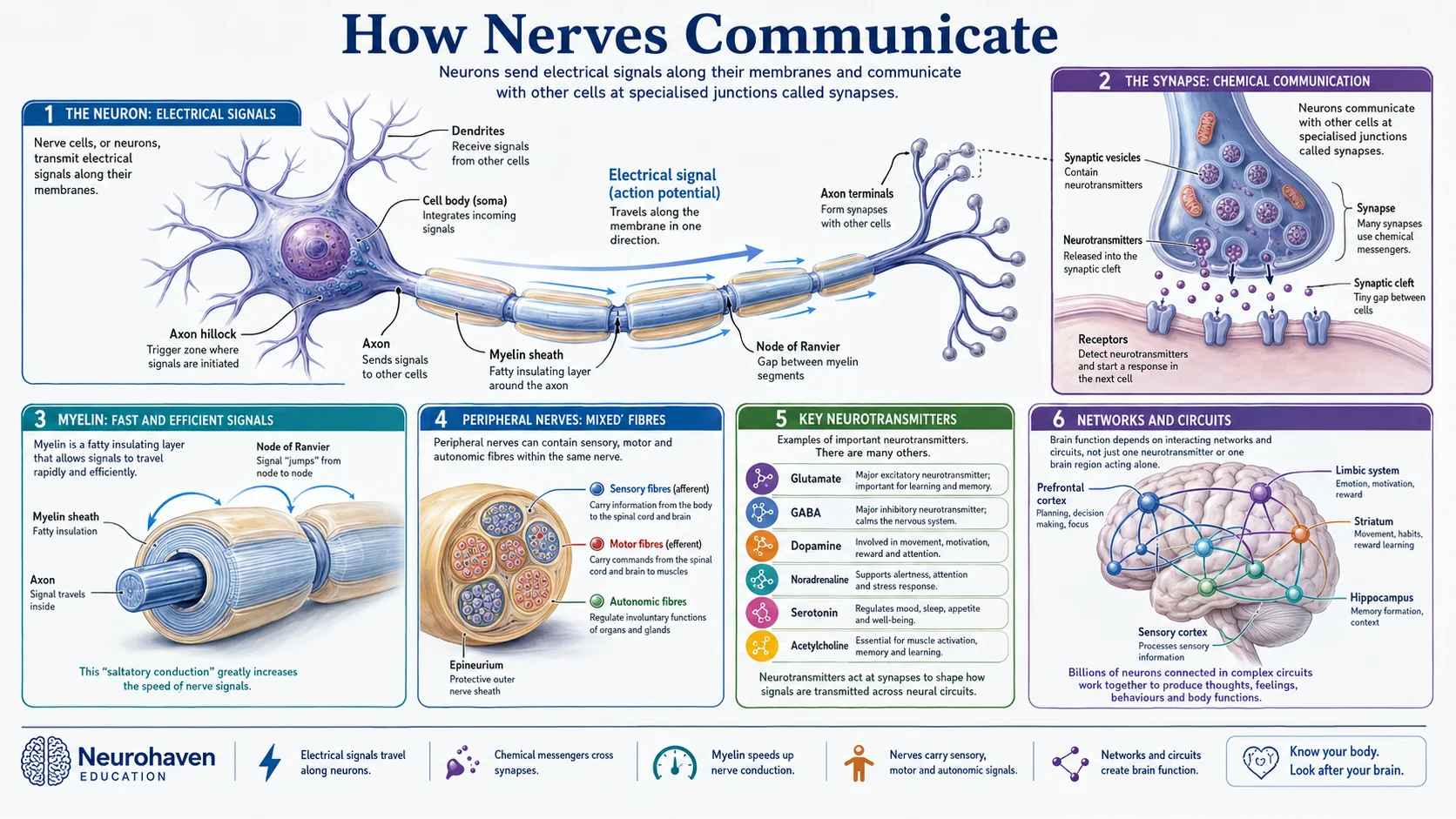
Nerve cells, or neurons, transmit electrical signals along their membranes and communicate with other cells at specialised junctions called synapses. At many synapses, chemical messengers called neurotransmitters carry the signal across a tiny gap.
- Myelin is a fatty insulating layer around many nerve fibres that allows signals to travel rapidly and efficiently.
- Peripheral nerves can contain sensory, motor and autonomic fibres within the same nerve.
- Neurotransmitters include glutamate, GABA, dopamine, noradrenaline, serotonin and acetylcholine, among many others.
- Brain function depends on networks and circuits rather than one neurotransmitter or one brain region acting alone.
8. Common neurological conditions
Migraine – A neurological disorder that can cause recurrent headache, nausea, sensitivity to light or sound and, in some people, aura.
Epilepsy – A tendency to have recurrent seizures caused by abnormal bursts of electrical activity in the brain.
Stroke – Sudden brain injury caused by interruption of blood flow or bleeding. Rapid recognition and emergency treatment are essential.
Peripheral neuropathy – Damage to peripheral nerves causing symptoms such as numbness, tingling, burning pain, weakness or loss of balance.
Multiple sclerosis – An immune-mediated disorder in which inflammation damages myelin within the brain and spinal cord.
Parkinson’s disease – A progressive neurological condition particularly affecting movement, but also sleep, mood, cognition and autonomic function.
Dementia – A group of conditions causing progressive impairment of memory and/or other cognitive abilities sufficient to affect daily functioning.
Motor neurone disease – A group of progressive conditions affecting motor neurons, leading to muscle weakness and wasting.
Functional neurological disorder (FND) – Neurological symptoms caused by altered functioning of nervous-system networks rather than structural damage that fully explains the symptoms. Symptoms are real and can include weakness, seizures, tremor or sensory changes.
Nerve compression – Conditions such as carpal tunnel syndrome or radiculopathy can occur when peripheral nerves or nerve roots are compressed or irritated.
9. Symptoms worth knowing
• New weakness in the face, arm or leg
• Numbness, tingling, burning or altered sensation
• Persistent or unusual headache
• Seizures or unexplained episodes of loss of awareness
• Problems with balance, coordination or walking
• Tremor, stiffness or involuntary movements
• Changes in vision, speech, swallowing or hearing
• New memory, language or cognitive difficulties
• Persistent nerve pain
• Loss of bladder or bowel control associated with neurological symptoms
10. Neurological emergencies
|
Call 999 or seek urgent emergency assessment for: • sudden facial droop, arm weakness or speech difficulty (possible stroke) • a first seizure, a prolonged seizure, repeated seizures without recovery, or serious injury during a seizure • sudden severe “thunderclap” headache • sudden loss of consciousness or severe new confusion • rapidly developing weakness, paralysis or difficulty breathing • new weakness or numbness with loss of bladder/bowel control or numbness around the saddle area • sudden loss of vision or a major new neurological deficit |
11. How doctors investigate the nervous system
Neurological examination – Assesses strength, sensation, reflexes, coordination, eye movements, gait and cranial-nerve function.
MRI – Provides detailed images of the brain, spinal cord, nerves and surrounding structures.
CT scan – Often used rapidly in emergencies such as suspected stroke, head injury or bleeding.
EEG – Records electrical activity from the brain and can support assessment of seizures and epilepsy.
Nerve-conduction studies and EMG – Assess electrical function of peripheral nerves and muscles.
Lumbar puncture – Samples cerebrospinal fluid when infection, inflammation or other neurological conditions are suspected.
Blood tests – Can identify metabolic, nutritional, endocrine, inflammatory, infectious or autoimmune contributors.
Cognitive or neuropsychological testing – Assesses domains such as attention, memory, language, processing speed and executive function when needed.
12. Protecting nervous-system health
Protect vascular health – Do not smoke, manage blood pressure, diabetes and cholesterol, and remain physically active. Brain health and cardiovascular health are closely linked.
Sleep – Adequate sleep supports attention, memory, emotional regulation and brain recovery.
Exercise – Regular physical activity supports brain, nerve, vascular and musculoskeletal health.
Nutrition – A balanced diet helps prevent deficiencies such as vitamin B12 deficiency that can affect nerve function.
Alcohol and drugs – Excess alcohol and some recreational substances can damage nerves or increase the risk of seizures, stroke and injury.
Protect the head and spine – Use appropriate helmets, seat belts and occupational safety measures.
Seek assessment – Progressive weakness, persistent sensory changes, recurrent seizures or new neurological symptoms should be medically assessed.
13. Mind × Body
The nervous system is where physical health, mental health and experience meet. Stress, sleep, pain, hormones, inflammation, medication and emotional state can all alter nervous-system function. Equally, neurological illness can affect mood, behaviour, cognition, sleep and identity.
Symptoms can be both neurological and influenced by psychological state at the same time. A mind-body explanation should never be used to dismiss symptoms or imply that they are imagined.
ADHD and the nervous system
ADHD is a neurodevelopmental condition involving differences in brain networks supporting attention, executive control, motivation, reward processing and self-regulation. It is not explained by one brain area or a simple “dopamine deficiency”.
- Frontal and frontostriatal networks are important in attention, working memory, inhibition and task regulation.
- Catecholamines, particularly dopamine and noradrenaline, are important modulators within these networks.
- Sleep disorders, neurological illness, pain, substance use and some medical conditions can worsen attention and executive functioning and should be considered when clinically relevant.
- Stimulant and non-stimulant ADHD medicines alter neurotransmitter signalling; they do not “switch on” a single underactive brain region.