
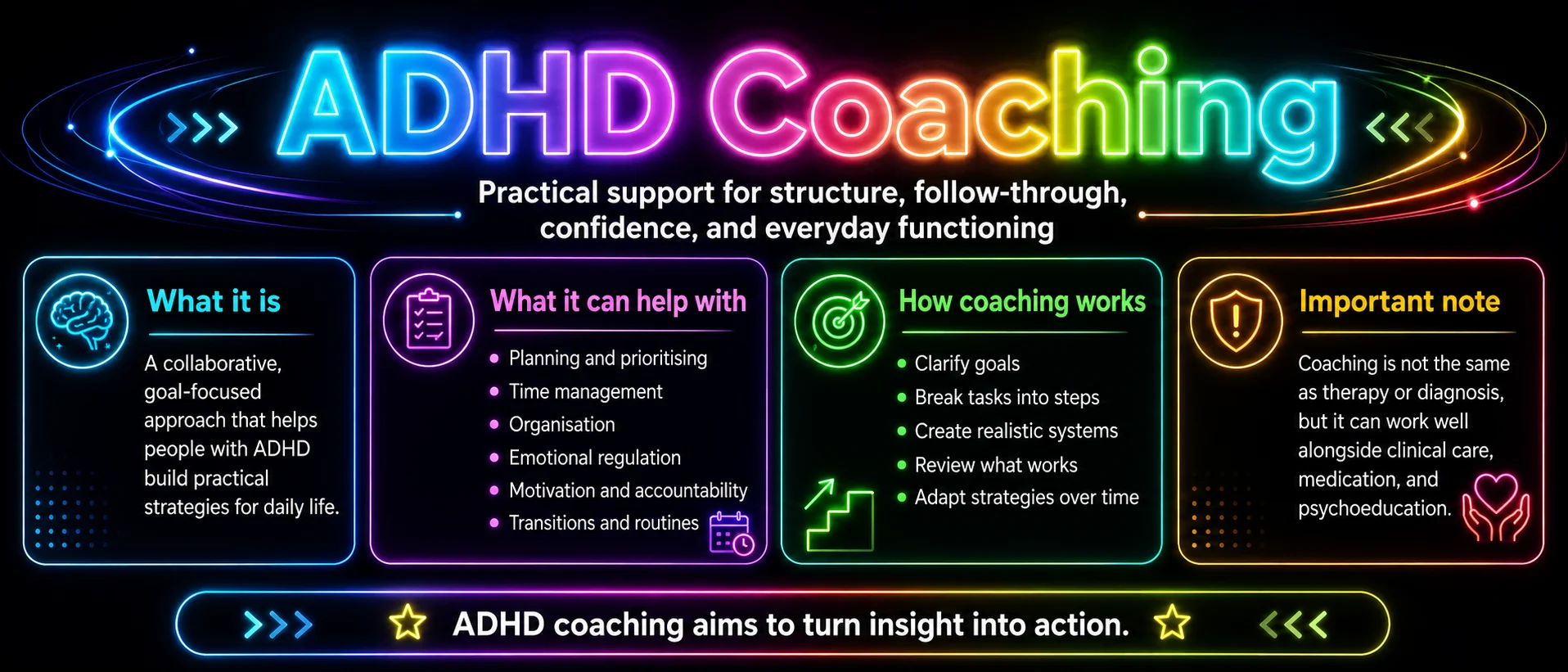
Evidence, practical strategies and choosing appropriate support
Updated guide • August 2026
|
In brief ADHD coaching is a collaborative, goal-focused form of support that helps people translate intentions into workable systems, routines and actions. It can be particularly useful for planning, prioritisation, time management, task initiation, organisation, accountability and adapting the environment to fit an ADHD brain. It is not a diagnostic service, psychotherapy, or a substitute for medical assessment or treatment when those are needed. |
The evidence base is developing. Structured skills-based and ADHD-focused psychological approaches have evidence for improving functioning, while research specifically on ADHD coaching remains smaller and more heterogeneous. A 2026 prospective study of 12-session individual ADHD coaching reported improvements in ADHD symptoms, executive functioning, functional impairment and goal attainment, but because it had no control group it cannot establish causation on its own. NICE does not name coaching as a standalone treatment; for adults who need non-pharmacological treatment, NICE recommends a structured supportive psychological intervention focused on ADHD with regular follow-up, which may include CBT elements.
Key learning points
|
Purpose |
Turn goals into practical, sustainable action by improving self-management, structure, awareness and accountability. |
|
Best fit |
Functional difficulties such as planning, procrastination, time blindness, disorganisation, inconsistent routines, work/study systems and follow-through. |
|
Not the same as therapy |
Coaching generally focuses more on current goals, behaviour, systems and implementation; psychotherapy can address mental illness, trauma, entrenched emotional patterns and clinical formulation. |
|
Not diagnosis or prescribing |
A coach should not diagnose ADHD, change medication, or provide medical advice unless they separately hold an appropriate regulated clinical qualification and are acting within that role. |
|
Evidence |
Promising but less mature than the evidence base for medication and structured psychological interventions such as ADHD-focused CBT. |
|
Quality matters |
“ADHD coach” is not a single protected clinical title in the UK. Training, ethics, supervision, scope of practice, safeguarding and transparent credentials therefore matter. |
1. What ADHD coaching is
ADHD coaching is a collaborative, client-led and goal-oriented process in which the coach and client identify meaningful aims, clarify barriers, experiment with practical strategies and review what actually works in everyday life. It applies general coaching principles through an ADHD-informed lens, recognising that difficulties with activation, working memory, time perception, sustained attention, inhibition and emotional regulation can make ordinary productivity advice difficult to implement consistently.
A good coach does not simply tell someone to “try harder” or supply a generic productivity system. The work is usually iterative: simplify the goal, make the next action visible, reduce friction, externalise memory, design prompts, anticipate derailers, practise the strategy, review the result and adjust. The aim is greater autonomy over time rather than permanent dependence on the coach.
Coaching, psychotherapy and clinical treatment: where they overlap and differ
|
Area |
ADHD coaching |
Psychotherapy / CBT |
Clinical ADHD care |
|
Primary focus |
Current goals, implementation, systems, accountability, strengths and functional change. |
Psychological formulation, thoughts, emotions, behaviours, distress, coping, mental health and/or trauma depending on modality. |
Diagnosis, differential diagnosis, risk, medication, physical monitoring, treatment planning and clinical follow-up. |
|
Typical questions |
What matters now? What is getting in the way? What is the smallest workable next step? |
What patterns maintain distress? How can thoughts, behaviours and emotional responses change? |
Does the person meet diagnostic criteria? What treatment is indicated and safe? |
|
Medication |
No prescribing or medication adjustment unless separately qualified and acting clinically. |
Usually not prescribed by therapist unless separately medically qualified. |
May include initiation, titration, monitoring and shared-care planning by an appropriate prescriber. |
|
Mental health risk |
Should recognise limits, signpost and escalate appropriately. |
Can assess and treat within professional competence; regulated roles have defined duties. |
Clinical assessment and risk management are core responsibilities. |
2. What coaching may help with
The most useful coaching targets are usually concrete and observable. The following domains commonly appear in ADHD coaching, although priorities should be individualised rather than assumed from diagnosis alone.
Planning and prioritisation: Choosing what matters, distinguishing “important” from merely stimulating or urgent, sequencing tasks, estimating effort and setting realistic daily capacity.
Task initiation and procrastination: Reducing activation barriers, defining the first visible action, using body doubling, start rituals, timers and deliberately small entry points.
Time management and time blindness: Externalising time through calendars, countdowns, transition buffers, visual clocks and realistic duration estimates based on actual data.
Working memory and follow-through: Moving information out of the head and into reliable capture systems, reminders, checklists, dashboards and environmental cues.
Organisation: Creating simple homes for physical and digital items, reducing decision load, designing reset routines and limiting unnecessary complexity.
Attention and distraction management: Matching tasks to energy and context, reducing competing cues, creating focus environments and planning purposeful breaks.
Motivation and reward: Making delayed rewards more immediate, adding novelty or interest appropriately, using visible progress and connecting tasks with personally meaningful goals.
Emotional self-management: Recognising escalation early, pausing before action, naming triggers, planning recovery and separating a strong emotional response from the decision that follows it.
Work and study: Planning workloads, meeting deadlines, preparing for meetings/exams, communicating needs and integrating reasonable adjustments where appropriate.
Home and relationships: Routines, shared calendars, division of tasks, reducing forgotten commitments, and improving clarity around expectations and communication.
3. Who may benefit?
|
Group |
Potential coaching focus |
|
Adults with ADHD |
Routines, household management, finances, appointments, procrastination, personal goals and balancing competing responsibilities. |
|
Students and trainees |
Study systems, assignment planning, revision, attendance, transition between tasks, deadlines and self-advocacy. |
|
Professionals and entrepreneurs |
Prioritisation, project completion, delegation, meeting preparation, email/task systems, strategic focus and burnout prevention. |
|
Parents and carers |
Parent coaching can focus on structure, communication, co-regulation, realistic expectations and consistent routines; this is distinct from treating the child. |
|
Couples and families |
Some coaches work with shared systems and communication, but significant relationship distress may require couples or family therapy instead or as well. |
|
People awaiting or alongside treatment |
Coaching may support function while someone is navigating services or complement clinical treatment, provided it is not presented as a replacement for assessment or indicated healthcare. |
4. Main features of effective ADHD coaching
Personalised formulation of the problem
Rather than assuming every difficulty is “because of ADHD”, coaching should clarify the actual task, context, strengths, competing demands, sleep, environment, motivation and co-existing difficulties. The coaching plan should be specific enough that progress can be observed.
Collaborative goals
Goals should matter to the client and be translated into behaviours. “Be more organised” becomes something testable, such as processing the inbox at 16:30 on three weekdays or preparing tomorrow’s top three tasks before finishing work.
External structure and accountability
Regular sessions, agreed experiments and brief progress review can provide scaffolding while new routines become more stable. Accountability should be supportive rather than shaming.
Skills and systems
Coaching commonly uses calendars, task managers, visual reminders, time estimates, checklists, environmental design, body doubling and review systems. The best tool is the one that is simple enough to be used consistently.
Strengths-based practice
ADHD-informed coaching should recognise strengths such as creativity, rapid idea generation, humour, curiosity, energy, persistence in areas of interest and unconventional problem-solving, without romanticising impairment.
Review and adaptation
A failed system is information. Effective coaching asks why it failed, removes friction, changes the cue or timing, reduces steps and tests again.
Boundaries and escalation
A coach should recognise when a client needs medical, psychological, safeguarding, substance-use, crisis or other specialist support and should be clear about what falls outside the coaching role.
5. Practical techniques used in coaching
Time blocking — Reserve defined periods for categories of work, including breaks and transition time. Blocks should reflect realistic capacity rather than an idealised day.
Short focus sprints — Pomodoro-style intervals can help some people, but the interval length should be adjusted. Twenty-five minutes is not a clinical rule; some people work better with 10, 15, 40 or 60 minutes.
Task chunking — Break a vague project into actions that can be started without further planning. “Do tax return” may become “open last year’s folder”, “download bank statement” and “find accountant email”.
The first-step method — Define the smallest physical action that creates momentum. This is especially useful when overwhelm is caused by task ambiguity.
Body doubling — Work in the presence of another person, physically or virtually. The other person need not assist; shared presence can increase activation and reduce drift for some people.
Visualisation and external cues — Use visible calendars, boards, launch pads, labelled storage, medication prompts, object placement and “out of sight = out of mind” countermeasures.
Implementation intentions — Use simple if–then plans: “If I finish lunch, then I open the project tracker before checking messages.”
Habit stacking — Attach a new action to a stable existing cue, but avoid chains that are so long that one missed step collapses the routine.
Environmental modification — Reduce friction for desired behaviours and increase friction for distractions: prepare materials in advance, silence non-essential alerts, separate work and leisure browsers, or place distracting apps behind limits.
Weekly review — Look at commitments, unfinished tasks, deadlines, energy demands and upcoming transitions. The purpose is not to create a perfect system but to prevent repeated surprises.
Techniques are tools, not rules
|
Avoid turning productivity advice into another source of failure. The “two-minute rule”, Pomodoro timers, SMART goals and the Eisenhower Matrix can be useful, but none is ADHD-specific treatment and none works for everyone. Coaching should adapt the technique to the person rather than judge the person by the technique. |
6. What does the evidence say?
The research literature supports structured, skills-based approaches for adults with ADHD, but the evidence specifically labelled “ADHD coaching” is smaller and varies in population, format and methodological quality. Much of the earlier coaching literature involved university students or interventions that combined coaching with cognitive-behavioural or executive-function training.
|
Evidence source |
What it tells us |
Interpretation |
|
NICE NG87 (current guideline) |
For adults needing non-pharmacological treatment, NICE recommends a structured supportive psychological intervention focused on ADHD with regular follow-up; treatment may include CBT elements. Medication remains the recommended treatment for adults whose symptoms continue to cause significant impairment after environmental modifications. |
Coaching can be complementary, but it should not be described as the NICE-recommended equivalent of medication or ADHD-focused psychological treatment. |
|
Scoping review of adult ADHD psychological treatment (2021/2022) |
Identified a substantial coaching literature, including an RCT and numerous student-focused studies, but highlighted heterogeneity and overlap with other approaches. |
Suggests coaching is clinically relevant, while making it difficult to isolate a single standardised “coaching effect”. |
|
Prospective adult ADHD coaching study (2026) |
A manualised 12-session individual coaching programme found statistically significant pre–post improvements in ADHD symptoms, executive functioning and functional impairment, with medium-to-large effect sizes and positive goal attainment. |
Encouraging contemporary evidence, but the single-arm design and relatively homogeneous sample mean controlled replication is needed. |
|
Skills-based interventions review (2026 abstract) |
Across goal-oriented, occupational, executive-coaching and emotion-regulation interventions, controlled evidence was mixed; non-controlled studies often showed within-group gains. |
Supports cautious optimism and the need for stronger controlled trials rather than overclaiming effectiveness. |
Bottom line: ADHD coaching is best presented as a practical, potentially valuable adjunct or support approach with a growing but not yet definitive evidence base. Claims that it “treats” ADHD, replaces diagnosis, or is proven equivalent to medication or structured psychological treatment should be avoided.
7. When coaching is not enough
Coaching can be helpful, but some presentations need clinical assessment or treatment rather than coaching alone. A responsible coach should have clear escalation and safeguarding procedures.
• New or worsening suicidal thoughts, self-harm, psychosis, mania, severe depression, severe anxiety or other acute mental-health deterioration.
• Significant alcohol or drug dependence, intoxication/withdrawal risk, or behaviour creating immediate safety concerns.
• Eating-disorder symptoms, domestic abuse, safeguarding concerns, serious financial exploitation or other major vulnerability.
• Unexplained physical symptoms or medication concerns that require medical review.
• Diagnostic uncertainty: coaching should not be used to “confirm” ADHD or rule out alternative explanations.
• Persistent trauma-related symptoms or relationship problems requiring therapy rather than goal-focused coaching alone.
8. Choosing an ADHD coach
Because coaching titles are not equivalent to regulated healthcare professions, it is sensible to check training, ethics, experience and scope carefully. Membership of a professional organisation is useful context, but it is not a guarantee of clinical competence or of a good personal fit.
|
Ask about |
What a reassuring answer might include |
|
Training and credentials |
Recognised coach training, ADHD/neurodiversity-specific education, clear explanation of credentialing body and current continuing professional development. |
|
Experience |
Specific experience with adults, students, executives, parents or other population relevant to you. |
|
Ethics and confidentiality |
Written agreement, confidentiality policy, data protection, boundaries, conflicts of interest and complaints process. |
|
Scope of practice |
Clear statement that coaching does not diagnose ADHD or replace medical/psychological care; defined approach to referrals and emergencies. |
|
Supervision / reflective practice |
Regular professional supervision, mentoring or structured reflective practice appropriate to the coach’s professional framework. |
|
Approach |
Collaborative, strengths-aware and practical; avoids shame, miracle claims, rigid one-size-fits-all systems and pressure to buy large packages before fit is established. |
|
Outcomes |
Agrees how progress will be reviewed: goal attainment, functional change, consistency, reduced overwhelm, or other client-defined outcomes. |
|
Accessibility |
Session format, frequency, written summaries, reminder systems, cancellation policy, communication between sessions and reasonable adjustments. |
Red flags
• Claims to diagnose ADHD through coaching alone.
• Advises starting, stopping or changing prescribed medication without appropriate clinical qualification.
• Promises a cure, guaranteed transformation or a single proprietary method that works for everyone.
• Discourages appropriate medical or psychological treatment.
• Cannot explain confidentiality, safeguarding, professional boundaries or complaint routes.
• Uses shame, confrontation or moral judgement when executive-function difficulties recur.
9. Formats and delivery
|
Format |
Potential advantages |
Considerations |
|
1:1 coaching |
Highly personalised, easier to work on sensitive or complex functional goals. |
Usually more expensive; quality and fit depend heavily on the individual coach. |
|
Group coaching |
Peer normalisation, shared ideas, lower cost, built-in accountability. |
Less individual time; confidentiality and group fit matter. |
|
Online coaching |
Convenient, accessible, easier to integrate with digital tools and screen-sharing. |
Home distractions, video fatigue and privacy need consideration. |
|
Workplace / executive coaching |
Can focus directly on role performance, leadership, delegation, meetings and workload systems. |
Clarify who the client is, what information is shared with the employer and whether Access to Work or employer funding applies. |
|
Workshops / short courses |
Useful for learning a defined skill or trying an approach before committing. |
Education alone may not provide enough individual implementation support. |
10. Digital tools: use categories, not app loyalty
Apps change quickly, and a coaching system should survive a change of platform. Rather than prescribing a particular brand, choose the simplest tool that reliably covers the required function.
Calendar: Appointments, time blocks, deadlines, travel and transition buffers.
Task manager: A trusted place for actionable tasks, ideally with very few priority levels.
Capture tool: Fast collection of ideas and obligations before they disappear from working memory.
Timer / visual clock: Makes time visible and supports starts, transitions and breaks.
Focus controls: Notification reduction, website/app limits, do-not-disturb modes and dedicated work profiles.
Shared systems: Family calendars, shared shopping/task lists, team project boards and agreed communication channels.
11. Finding coaching and reputable resources
Directories and professional organisations can be useful starting points. Availability, credentials and services change, so verify current status directly before engaging a coach.
|
Organisation |
Why it may be useful |
Website |
|
ADHD Coaches Organization (ACO) |
International professional membership organisation focused specifically on ADHD coaching; provides information on ADHD coaching and a coach directory. |
https://www.adhdcoaches.org/ |
|
International Coaching Federation (ICF) |
Provides a Credentialed Coach Finder and credential verification. ICF itself advises users to verify information and assess fit. |
https://coachingfederation.org/ |
|
ADHD Foundation Neurodiversity Charity (UK) |
Provides ADHD/neurodiversity education and a coaching diploma pathway. Check the current website for service availability and programme status. |
https://www.adhdfoundation.org.uk/ |
|
ADDA – Attention Deficit Disorder Association |
Adult ADHD education, peer resources and coaching-related information, including material relevant to adults in the UK. |
https://add.org/ |
|
CHADD |
Large ADHD education and support organisation with information and referral resources, primarily US-based but internationally useful. |
https://chadd.org/ |
12. What a coaching cycle might look like
1. Clarify the goal — Choose one or two meaningful outcomes and define what “better” would look like in ordinary life.
2. Map the friction — Identify where the task breaks down: remembering, starting, sequencing, estimating time, sustaining effort, switching, emotional avoidance or environmental distraction.
3. Design one experiment — Create the smallest workable strategy. Avoid rebuilding the whole life-management system at once.
4. Make it visible — Add cues, calendar blocks, prompts, materials, accountability or environmental changes.
5. Test in real life — Use the strategy during the week and capture what happened rather than relying on memory.
6. Review without judgement — Keep what worked, modify what partly worked and discard what created more friction.
7. Generalise and reduce scaffolding — Once reliable, transfer the principle to another setting and gradually reduce unnecessary external support.
13. Frequently asked questions
Do I need a formal ADHD diagnosis before coaching?
Not always. Some coaches work with people who identify with ADHD-like executive-function difficulties. However, coaching should not be presented as a substitute for diagnostic assessment when a diagnosis is clinically or practically important.
Can coaching replace medication?
Not as a general rule. Medication has a stronger evidence base for reducing core ADHD symptoms in adults. Coaching may address implementation, habits and functional difficulties, and some people choose non-pharmacological approaches or cannot take medication. Treatment decisions should be individualised clinically.
Can coaching help emotional dysregulation or rejection sensitivity?
It may help with recognising triggers, pausing, communication and coping strategies. Severe or persistent emotional distress, trauma, mood disorder, anxiety or relationship difficulties may be better addressed by an appropriately qualified therapist or clinician, sometimes alongside coaching.
How often are sessions?
Common patterns include weekly or fortnightly sessions, but frequency should reflect need, affordability and the level of between-session support. There is no single evidence-based “correct” coaching frequency.
How long should coaching last?
Some people use a short block around a defined problem; others benefit from a longer period during major transitions. A good arrangement should include planned review points rather than open-ended continuation by default.
Conclusion
ADHD coaching can provide practical structure, accountability and skill development for people who know what they want to do but struggle to translate intention into consistent action. Its strongest role is often functional: making goals concrete, externalising executive functions, reducing friction and developing systems that are realistic enough to survive ordinary life.
The most accurate contemporary position is neither to dismiss coaching nor to oversell it. The evidence is promising and expanding, but remains less definitive than for established ADHD treatments. High-quality coaching should therefore be ADHD-informed, collaborative, ethically bounded, transparent about credentials, responsive to risk and integrated with clinical care when clinical care is required.
Selected references and guidance
• National Institute for Health and Care Excellence (NICE). Attention deficit hyperactivity disorder: diagnosis and management (NG87). Published 14 March 2018; last updated 13 September 2019. Recommendations 1.5.15–1.5.18. https://www.nice.org.uk/guidance/ng87
• NICE. Rationale and impact: managing ADHD – adults. NG87. https://www.nice.org.uk/guidance/ng87/chapter/Rationale-and-impact
• Coaching for Adults With ADHD: A Prospective Study. Journal article indexed in PubMed, 2026. PMID: 41909194. https://pubmed.ncbi.nlm.nih.gov/41909194/
• Young S, et al. The impact of psychological theory on the treatment of Attention Deficit Hyperactivity Disorder (ADHD) in adults: a scoping review. 2021/2022. PMCID: PMC8691636.
• Recent developments in the psychosocial treatment of adult ADHD. Review including discussion of coaching and structured skills-based approaches. PMCID: PMC2628311.
• Investigating the Effects of Skills-Based Training Interventions on Executive and Psychosocial Functioning in Adults with ADHD – A Systematic Review of Practical, Emotional and Cognitive Approaches. BJPsych Open abstract collection, 2026; note that the collection states abstracts were not subjected to standard BJPsych Open peer review. PMCID: PMC13325030.
• ADHD Coaches Organization. About ADHD Coaching; Standards and Expectations. Accessed 27 August 2026. https://www.adhdcoaches.org/
• International Coaching Federation. Credentialed Coach Finder and education/credential information. Accessed 27 August 2026. https://coachingfederation.org/
• ADHD Foundation Neurodiversity Charity. Training and ADHD Coaching Diploma information. Accessed 27 August 2026. https://www.adhdfoundation.org.uk/
|
Important This guide is educational. It does not diagnose ADHD, recommend a particular coach, or replace personalised medical or psychological advice. Credentials, services and organisational information can change; verify current details directly with the relevant provider or professional body. |