

Current evidence increasingly supports a lifespan approach to female ADHD, recognising that presentation, impairment and treatment needs can change from childhood through puberty, reproductive life, pregnancy and the postnatal period, and into perimenopause and menopause.
ADHD affects people of all sexes and genders, but for many years its recognition was strongly influenced by research and clinical descriptions based predominantly on boys and men. As a result, ADHD in girls and women has often been identified later, overlooked entirely, or initially attributed to anxiety, depression, stress, personality, hormonal problems or poor coping.
Oestrogen, dopamine and ADHD in females
There is a compelling biological rationale for why hormonal change may influence ADHD symptoms in some females. Oestrogen, particularly 17β-oestradiol, modulates dopaminergic signalling in brain systems involved in attention, reward, motivation, working memory and executive control. Experimental research indicates that oestrogen can influence dopamine synthesis, release, receptor signalling and metabolism; however, its effects are complex, vary across brain regions and cannot be reduced to the simple idea that “more oestrogen means more dopamine.”
In their influential 2021 paper, Littman, Dean, Wagenberg and Wasserstein drew attention to the possibility that changing oestrogen levels across the female lifespan may alter the expression of ADHD. They proposed that puberty, the menstrual cycle, pregnancy and particularly the transition through perimenopause and menopause may create periods in which existing vulnerabilities in attention and executive functioning become more noticeable. This was an important conceptual contribution because ADHD research had historically paid relatively little attention to female reproductive physiology.
Subsequent research has strengthened the case that this relationship deserves serious investigation. A 2025 systematic review by Osianlis and colleagues identified 11 studies examining ADHD symptoms in relation to female sex hormones. Overall, the findings were suggestive of hormone-related changes in ADHD symptoms, particularly during puberty and across the menstrual cycle, but the authors emphasised that studies remain few, often small and methodologically heterogeneous. Evidence concerning menopause remains particularly limited.
A major 2025 European review led by Sandra Kooij, involving the EUNETHYDIS Special Interest Group on Female ADHD, similarly concluded that hormonal transitions may affect ADHD symptoms, cognition and mood. The authors highlighted the interaction between ovarian hormones and dopamine as one plausible mechanism and noted clinical observations of worsening concentration, executive difficulties and emotional symptoms during periods of hormonal fluctuation. Importantly, they also stressed that pharmacological and longitudinal research remains insufficient and that tailored treatment approaches have not yet been established.
The emerging picture is therefore biologically plausible and increasingly supported, but not yet proven in a simple causal sense. We can confidently say that oestrogen interacts with dopamine systems and that some females with ADHD report clinically meaningful changes in symptoms during hormonal transitions. What we cannot yet say is that falling oestrogen directly causes a specific “dopamine deficiency,” that menopause inevitably worsens ADHD, or that ADHD medication or hormone therapy should routinely be adjusted according to hormone levels.
The most defensible conclusion is that female hormones may act as modulators of an existing neurodevelopmental vulnerability. For some women, changes in oestrogen may alter the functioning of neural systems already relevant to ADHD, helping to explain why symptoms can fluctuate across the menstrual cycle or become more apparent during perimenopause. Wasserstein and colleagues helped bring this overlooked relationship into clinical discussion; more recent systematic and expert reviews increasingly support its importance, while also making clear that the science is still developing.
Why ADHD Can Be Missed in Girls and Women
ADHD does not necessarily look fundamentally different in females, and women can experience inattentive, hyperactive and impulsive symptoms. However, the way these difficulties are expressed, compensated for or noticed by other people can differ.
Girls are diagnosed with ADHD considerably less frequently than boys during childhood, while the sex difference becomes much smaller in adulthood. This does not mean that ADHD suddenly develops in women during adult life. Rather, a proportion of women appear to have had longstanding symptoms that were not identified earlier.
Factors contributing to delayed recognition can include:
predominantly inattentive rather than disruptive symptoms;
internal restlessness rather than obvious physical hyperactivity;
excessive talking, interrupting or emotional impulsivity being interpreted as personality;
strong academic ability masking executive dysfunction;
perfectionism and over-preparation as compensatory strategies;
considerable effort being required to maintain apparently normal performance;
structured family or educational environments concealing difficulties;
anxiety, depression or eating problems attracting clinical attention before ADHD is considered;
social expectations encouraging girls to suppress disruptive behaviour;
symptoms becoming more apparent only when environmental demands increase.
Research from UK healthcare records also suggests that women are more likely than men to have received diagnoses such as anxiety or depression before ADHD is eventually recognised, raising the possibility of diagnostic overshadowing in some cases.
What ADHD May Look Like in Adult Women
There is no single "female ADHD" presentation. Nevertheless, frequently reported difficulties include chronic disorganisation, losing or forgetting things, difficulty initiating tasks, inconsistent concentration, procrastination, poor time awareness, unfinished projects and problems prioritising competing demands.
Some women describe periods of intense concentration or hyperfocus, particularly when something is novel, urgent or personally interesting, alongside marked difficulty sustaining attention for routine or unrewarding tasks.
Hyperactivity may become less visibly physical with age and may instead be experienced as inner restlessness, constant mental activity, excessive talking, difficulty relaxing, persistent multitasking or feeling driven to remain busy.
Impulsivity may include interrupting, rapid decision-making, spending, changing plans abruptly, emotional reactions, impatient behaviour or difficulty pausing before acting.
Importantly, ADHD is diagnosed on the basis of the overall pattern of neurodevelopmental symptoms, childhood onset and clinically significant impairment, rather than any single characteristic.
Masking and Compensation
A woman can appear highly organised while expending extraordinary effort to remain organised.
Many women develop compensatory systems such as multiple calendars, lists, reminders, alarms, rigid routines, extensive preparation or repeatedly checking their work. These strategies can be extremely effective, but they can also conceal the severity of the underlying executive-function difficulty.
For some people, maintaining these systems produces significant exhaustion. Difficulties may become substantially more obvious when demands increase—for example when starting university, entering a demanding career, becoming a parent, managing a household, caring for relatives or moving into senior professional roles.
This is sometimes described informally as masking, although masking is not itself a diagnostic criterion for ADHD.
ADHD, Emotional Regulation and Burnout
Emotional dysregulation is commonly reported in ADHD and may include rapid emotional reactions, frustration intolerance, difficulty recovering after stress and feeling overwhelmed by competing demands.
Although emotional dysregulation is not one of the core DSM-5-TR diagnostic criteria for ADHD, it is clinically important and can contribute substantially to impairment.
For some women, years of compensating for executive difficulties, attempting to meet occupational or family expectations and repeatedly feeling that ordinary tasks require disproportionate effort can contribute to chronic stress and burnout.
This should not automatically be attributed to ADHD. Anxiety disorders, depression, trauma, sleep disorders, autistic characteristics, physical illness and environmental stressors should also be considered where appropriate.
ADHD and Mental Health
Women with ADHD have increased rates of several co-occurring psychiatric and neurodevelopmental difficulties.
These can include:
anxiety disorders;
depressive disorders;
eating disorders;
substance-use difficulties;
sleep disturbance;
autism and other neurodevelopmental conditions;
emotional dysregulation.
Recognising comorbidity is particularly important because treating ADHD does not necessarily treat every accompanying condition.
Conversely, treatment directed solely towards anxiety or depression may leave substantial ADHD-related executive dysfunction untreated where ADHD is also present.
Comprehensive assessment should therefore consider the whole clinical picture rather than searching for a single explanation for every difficulty.
ADHD Across the Female Lifespan
One of the most important developments in female ADHD research concerns reproductive hormonal transitions.
Oestrogen and progesterone interact with several neurotransmitter systems, including dopaminergic and noradrenergic pathways relevant to cognition, attention and mood. This has led to increasing interest in whether changing reproductive hormone levels influence ADHD symptoms or the perceived effectiveness of ADHD medication.
Current research suggests that hormonal changes may influence ADHD symptoms in some women, but the evidence remains much smaller and less definitive than is sometimes suggested online. A 2025 systematic review identified only 11 relevant studies and concluded that the relationship appears plausible, particularly around puberty and the menstrual cycle, but that substantially more research is required.
Menstrual Cycle and ADHD
Some women report predictable fluctuations in attention, executive functioning, emotional regulation, sleep or perceived medication effectiveness during the menstrual cycle.
Difficulty may be particularly noticeable during the late luteal or premenstrual phase in some individuals.
Recent research supports further investigation of this phenomenon, including evidence of worsening cognitive or ADHD-related difficulties during certain menstrual phases, although available studies remain relatively small and heterogeneous.
A practical approach may include tracking:
ADHD symptoms;
mood;
sleep;
menstrual-cycle phase;
medication response;
significant functional impairment.
Several months of tracking can help determine whether an apparent pattern is consistent rather than coincidental.
What About Changing ADHD Medication During the Menstrual Cycle?
Some women report that stimulant medication feels less effective during particular phases of their cycle, and specialist literature has begun exploring whether individually tailored treatment may eventually be appropriate.
However, there is currently insufficient high-quality evidence to recommend routine menstrual-cycle-based stimulant dose adjustment for all women with ADHD.
Any medication change should therefore be discussed with the prescribing clinician and based on individual symptoms, tolerability, physical monitoring and clinical judgement rather than being undertaken independently.
Premenstrual Symptoms and PMDD
Premenstrual mood and cognitive symptoms may be particularly relevant for some women with ADHD.
Premenstrual dysphoric disorder, or PMDD, is a distinct clinical condition characterised by severe cyclical affective symptoms associated with the menstrual cycle. It should not automatically be assumed that severe premenstrual deterioration represents ADHD alone.
Where there is marked cyclical depression, irritability, anxiety, emotional instability or functional impairment, prospective symptom monitoring and appropriate clinical assessment are advisable.
Pregnancy and the Postnatal Period
Pregnancy and the postnatal period can alter sleep, daily structure, psychological demands and hormone levels, all of which may influence ADHD symptoms and functioning.
Management of ADHD medication during pregnancy or breastfeeding requires individualised risk-benefit assessment. Medication should not simply be stopped or continued on the basis of generic internet advice.
Relevant considerations include:
severity of untreated ADHD;
occupational and driving safety;
impulsivity and risk-taking;
ability to manage daily responsibilities;
previous response to medication;
maternal physical and mental health;
available reproductive-safety data for the specific medication;
breastfeeding plans.
Specialist advice may be appropriate where treatment decisions are complex.
Perimenopause and Menopause
Perimenopause is increasingly recognised as a potentially important period for women with ADHD.
Changes in reproductive hormones occur alongside possible alterations in sleep, mood, memory, concentration and executive functioning. Women may therefore experience new cognitive difficulties, worsening of longstanding ADHD symptoms or a reduction in the effectiveness of previously successful compensatory strategies.
Some women first seek assessment for ADHD during this period.
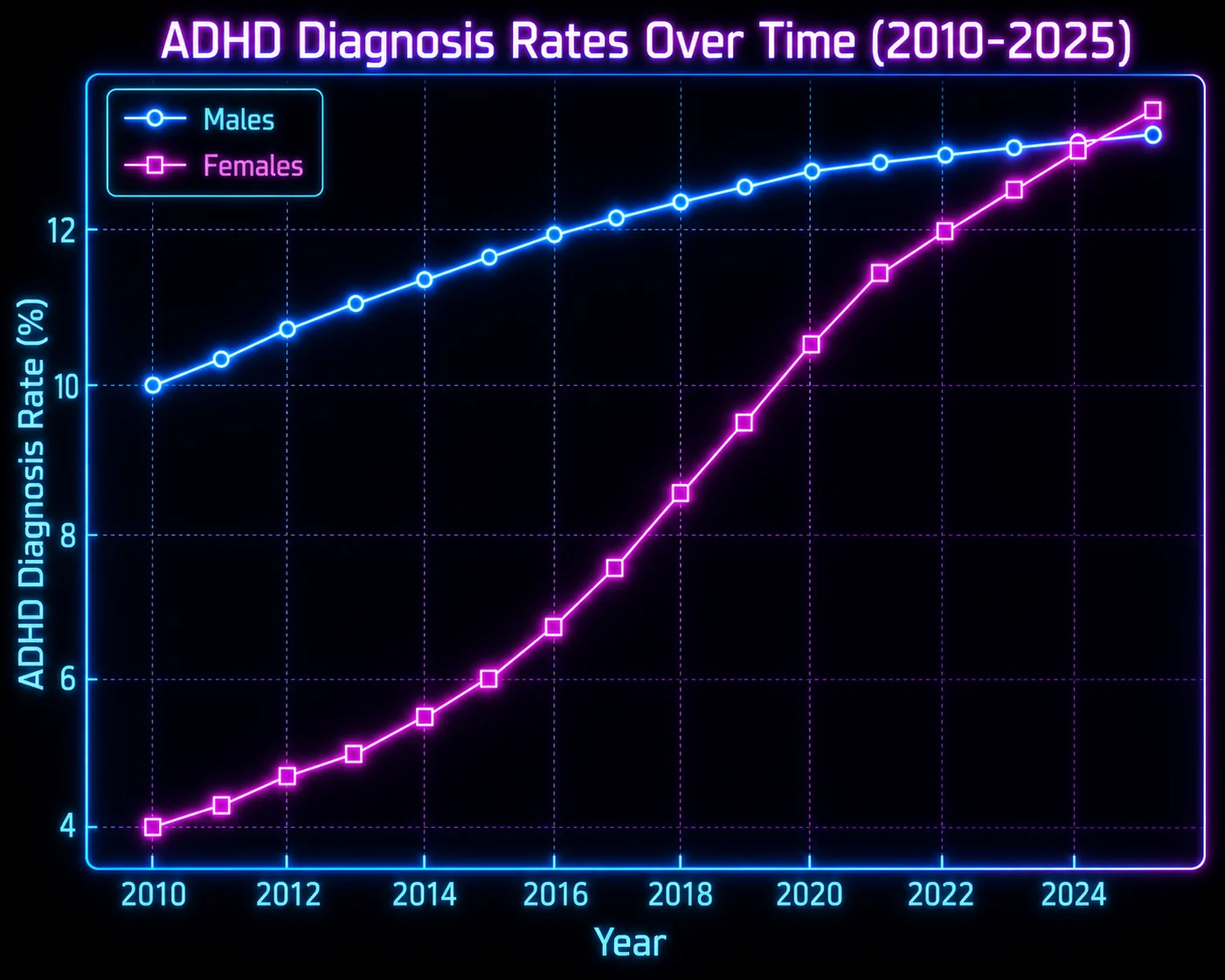
Research published during 2025 and 2026 has strengthened interest in the relationship between ADHD and hormonal transitions, but menopause-specific ADHD research remains limited and treatment recommendations are still developing.
Clinicians should avoid assuming that all new cognitive symptoms during midlife are ADHD. Sleep disorders, depression, anxiety, medication effects, thyroid disease, anaemia, menopause-related symptoms and other medical causes may also require consideration.
Diagnosis Rates in Females and Males
The traditional view of ADHD as predominantly a disorder of boys is increasingly recognised as incomplete.
During childhood, ADHD continues to be diagnosed substantially more frequently in boys than girls. Reviews suggest large male-to-female differences in clinically diagnosed childhood ADHD, while epidemiological differences are smaller. By adulthood, diagnosed male-to-female ratios become much closer.
This pattern probably reflects several interacting factors rather than one simple cause, including:
differences in average symptom presentation;
referral bias;
greater recognition of disruptive behaviour;
compensation and masking;
diagnostic overshadowing;
cultural expectations;
increased self-referral during adulthood.
There is therefore no single reliable "female versus male diagnosis ratio" that applies across every age group, population or healthcare system.
Age at Diagnosis
Women are, on average, more likely than men to receive an ADHD diagnosis later.
There is no universal female "peak diagnostic age", because diagnostic patterns vary considerably according to country, healthcare system and cohort.
The clinically important point is that symptoms may have been present throughout childhood even when impairment becomes unmistakable only later.
Common periods when previously compensated ADHD becomes more apparent include:
secondary school;
university;
transition into independent living;
demanding employment;
parenthood;
promotion into management;
periods of increased caregiving responsibility;
perimenopause.
A late diagnosis therefore does not necessarily imply late-onset ADHD.
Assessment of ADHD in Women
Assessment should use the same established diagnostic principles for women as for men.
A high-quality assessment considers:
Childhood onset
There should be evidence that relevant ADHD symptoms were present during the developmental period, even if they were not recognised as ADHD at the time.
Symptoms across settings
Difficulties should not be restricted to one isolated situation.
Clinically significant impairment
Symptoms should materially affect education, employment, relationships, household management, finances, driving, emotional wellbeing or other important areas of life.
Developmental history
School reports, parental information or other historical evidence can be useful where available, although absence of documentation does not by itself exclude ADHD.
Compensatory strategies
The assessor should explore how much effort is required to maintain functioning rather than judging impairment solely by external achievement.
Alternative explanations and comorbidity
Anxiety, depression, bipolar disorder, trauma, autism, sleep disorders, substance use and relevant medical conditions should be considered.
Screening questionnaires can support assessment but cannot establish an ADHD diagnosis on their own.
Treatment
Treatment should be individualised and may combine medication, psychological interventions, practical adaptations and education.
Medication
For adults with ADHD, evidence-based pharmacological options include stimulant and non-stimulant medication.
In UK practice these include medicines such as methylphenidate, lisdexamfetamine, dexamfetamine and atomoxetine, depending on individual circumstances and current clinical guidance.
Women do not generally require a fundamentally different class of ADHD treatment from men. Available evidence supports the effectiveness of established ADHD treatments in both sexes.
However, reproductive stage, pregnancy, breastfeeding, cardiovascular health, psychiatric comorbidity and possible cyclical symptom variation may influence individual treatment decisions.
Psychological and Practical Interventions
Medication is only one element of ADHD management.
Some people benefit from:
ADHD-focused cognitive behavioural therapy;
psychoeducation;
occupational or educational adjustments;
organisational strategies;
external reminders and scheduling systems;
ADHD-informed coaching;
treatment of co-occurring anxiety or depression;
sleep optimisation;
exercise and physical activity;
support with financial or household organisation.
The objective is not simply to reduce questionnaire scores. Effective treatment should improve real-world functioning, consistency, independence and quality of life.
Reliable Resources for Women with ADHD
The following organisations provide useful information, education or peer support. Inclusion does not constitute endorsement of every article, opinion, practitioner or commercial service associated with the organisation.
UK Resources
ADHD Girls
A UK-based social-impact organisation founded by Dr Samantha Hiew, focusing on ADHD, autism and neurodivergence in women. It provides education, events, professional training and community-based resources.
The organisation describes its current mission as empowering neurodivergent women and improving societal understanding of neurodiversity.
ADD-vance
A Hertfordshire-based organisation supporting families and individuals affected by ADHD and autism. Its work includes education, training and support programmes.
ADHD Women's Wellbeing
A UK resource and podcast associated with Kate Moryoussef, exploring adult ADHD, wellbeing, hormones, diagnosis and lived experience.
Podcasts and lived-experience material can be valuable sources of support, but they should complement rather than replace professional clinical advice.
International Resources
Duke Center for Girls & Women with ADHD
One of the strongest dedicated educational resources in this area. The Duke Center provides materials for girls, adult women, families, educators and healthcare professionals, including information on reproductive life stages and emerging research.
Its resource library includes material on later adulthood, puberty, pregnancy, postpartum mental health and female ADHD research.
ADDA – Attention Deficit Disorder Association
ADDA provides adult ADHD education, webinars and online peer-support communities, including a dedicated virtual group for women with ADHD.
Its current women's support programme includes regular virtual peer meetings and access to an online ADHD community. Some services require membership.
CHADD
CHADD is a long-established ADHD education and advocacy organisation based in the United States. Its resources cover adult ADHD, women, family life, work, treatment and practical management.
ADHD Australia
A national advocacy and information organisation providing ADHD education and links to Australian services and support.
ADDitude
ADDitude publishes a large volume of ADHD-focused articles, webinars and practical material, including extensive coverage of ADHD in women.
It can be a useful accessible educational resource, although readers should distinguish journalistic or expert-opinion material from formal clinical guidelines and primary research.
Current Advances in Female ADHD
Research into ADHD in women is developing rapidly. Particularly important areas include:
Earlier recognition of ADHD in girls. Greater attention is being paid to inattentive symptoms, compensatory strategies and diagnostic bias.
ADHD across reproductive stages. Puberty, menstrual cycles, pregnancy, the postpartum period and menopause are increasingly being investigated as potentially important modifiers of ADHD symptoms.
Hormone-related symptom variation. There is growing evidence that some women experience meaningful cyclical changes in cognition, mood or medication response, although the evidence remains preliminary and should not be overstated.
Perimenopause and later-life ADHD. This remains substantially understudied, but research attention is increasing.
Diagnostic overshadowing. Greater recognition is being given to women whose ADHD has previously been conceptualised exclusively as anxiety, depression or another psychiatric disorder.
Female-specific clinical research. Researchers are increasingly calling for studies designed specifically to investigate women rather than extrapolating findings predominantly derived from male samples.
The direction of travel is clear: clinicians should understand the ways in which ADHD may present and change across the female lifespan while avoiding the opposite error of assuming that every difficulty experienced by a woman with ADHD is caused by sex hormones.
Key Message
ADHD in women is not a separate disorder, but its recognition and clinical course can be influenced by sex, gender, social expectations, compensatory behaviour and reproductive hormonal changes.
Women may reach adulthood with considerable academic or occupational achievement while still experiencing substantial executive dysfunction and impairment behind the scenes. Recognition requires attention not only to visible behaviour, but also to developmental history, internal symptoms, the effort needed to maintain functioning and the consequences when compensatory systems fail.
Research into female ADHD has advanced considerably, particularly around hormonal life stages, but important gaps remain. The most appropriate approach is therefore one of individualised, evidence-based assessment and treatment, informed by emerging female-specific research without overstating what that research can currently prove.