
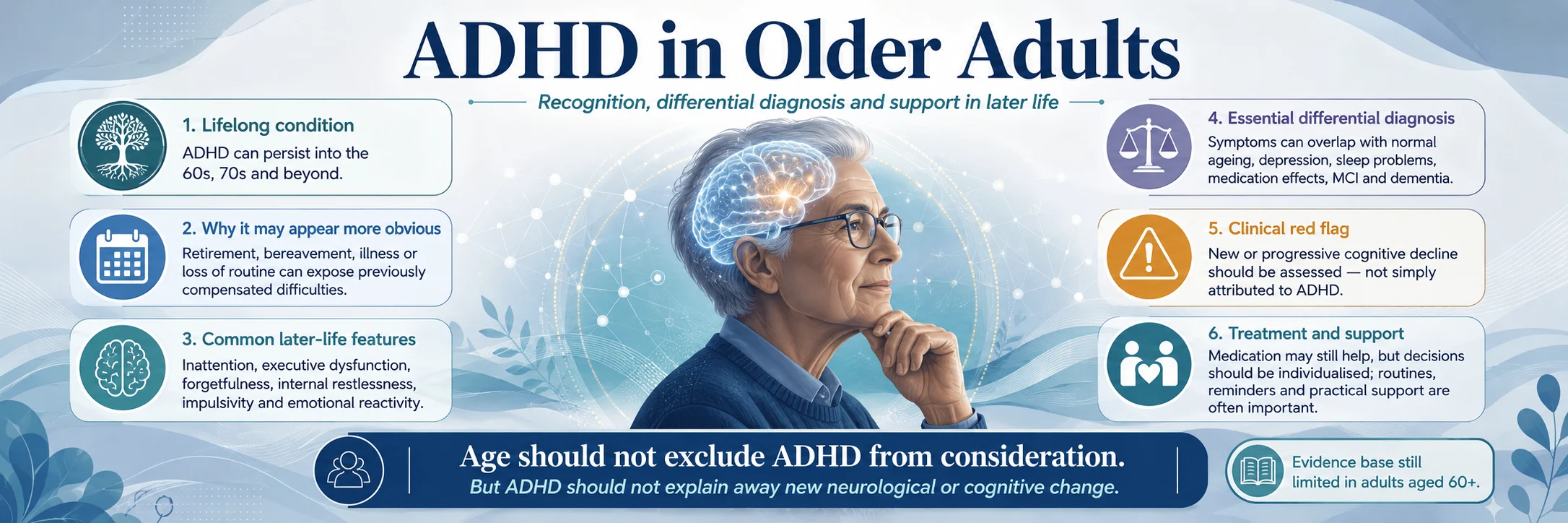
ADHD IN LATER LIFE
Recognition, differential diagnosis and treatment in adults aged 60 and over
Updated evidence-informed review • August 2026
|
Core principle ADHD can persist throughout the lifespan. Older age should not exclude ADHD from consideration, but ADHD should never be used to explain away new, progressive or otherwise unexplained cognitive decline. |
Evidence base
Research remains sparse. A 2024 scoping review identified only 17 eligible primary studies that included people aged 60 years or over. The available literature supports persistence of ADHD symptoms into later life, while also highlighting major gaps in age-specific diagnostic validation and treatment trials.
Executive summary
ADHD is a neurodevelopmental disorder, not a condition that ends at retirement. Symptoms may persist into the 60s, 70s and beyond, although their visibility and functional consequences can change when occupational structure, partners, routines or other compensatory supports change.
Later-life assessment requires stronger differential diagnosis than a simple symptom count. Inattention, forgetfulness and executive difficulties overlap with normal ageing, depression, anxiety, sleep disorders, medication effects, sensory impairment, physical illness, mild cognitive impairment (MCI) and dementia.
The single most useful discriminator is longitudinal course. ADHD requires a convincing developmental history with symptoms beginning in childhood and persisting across life. A substantial new decline from a person’s established baseline demands investigation for other causes.
Medication can remain appropriate, but the evidence base in older adults is limited. Chronological age alone is not a contraindication. Decisions should be individualised around cardiovascular risk, frailty, polypharmacy, sleep, appetite/weight, falls risk and psychiatric comorbidity, with careful titration and monitoring.
Treatment should address function as well as symptoms. Environmental modification, ADHD-focused psychological work, practical executive-function supports, occupational therapy where indicated, sleep and physical-health optimisation, and appropriate family involvement may all be useful.
What may differ from adults aged 18–65?
|
Domain |
Younger / mid-adulthood |
Later-life considerations |
|
Structure |
Work, study, parenting and deadlines may provide external scaffolding. |
Retirement, bereavement, reduced mobility or loss of routine may expose previously compensated executive difficulties. |
|
Hyperactivity |
Motor restlessness may remain obvious. |
May be more internalised: impatience, inability to relax, excessive talking, constant activity or discomfort with inactivity. |
|
Differential diagnosis |
Mood, anxiety, sleep, substance use and other neurodevelopmental disorders commonly overlap. |
Greater need to consider medication effects, sensory loss, vascular/neurological disease, MCI, dementia, frailty and multimorbidity. |
|
Medication |
Evidence base is much larger. |
Trial evidence after 60–65 is sparse; cardiovascular baseline risk and polypharmacy are more common, so titration and monitoring require extra care. |
|
Functional risks |
Employment, study, driving, relationships and parenting. |
Medication management, bills/pensions, appointments, falls, driving, isolation, maintaining independence and managing multiple illnesses. |
1. How ADHD may present in later life
- Inattention and executive dysfunction: Difficulties with sustaining attention, remembering intentions, sequencing tasks, prioritising, paperwork, appointments, household administration, medication routines and financial management may become especially prominent.
- Changing compensation: A person who functioned well in a demanding career may find retirement unexpectedly destabilising when deadlines, assistants, routines, urgency and external accountability disappear.
- Hyperactivity: Visible motor hyperactivity may lessen with age, but internal restlessness can remain. People may describe a persistent need to stay occupied, rapidly shifting activities, impatience, excessive talking or difficulty relaxing.
- Impulsivity: Impulsive spending, online purchasing, interrupting, hurried decisions, poorly considered commitments, impatient driving and emotionally driven actions may continue, although the context and consequences change.
- Emotional regulation: Emotional dysregulation is clinically common in adults with ADHD but is not itself a core DSM-5-TR diagnostic criterion. Irritability, low frustration tolerance and difficulty recovering from stress may remain highly impairing.
- Fatigue and reduced reserve: Sleep disruption, chronic illness, pain and reduced physiological reserve can make effortful compensatory strategies harder to sustain, exposing difficulties that were previously masked.
2. ADHD, normal ageing, MCI and dementia
The central question is not “Does this person forget things?” but “What is the developmental and longitudinal pattern?” Forgetfulness, distractibility and reduced organisational efficiency are non-specific symptoms. Their meaning depends on onset, trajectory, context and associated neurological or functional change.
|
Feature |
Longstanding ADHD |
Possible MCI / dementia |
Clinical implication |
|
Onset |
Symptoms trace back to childhood/adolescence, even if never diagnosed. |
New or clearly progressive difficulties later in life. |
New late-life onset is not explained by ADHD alone. |
|
Course |
Often chronic, variable with structure, stress, sleep and demands. |
Progressive decline may become increasingly evident over months/years. |
Compare with the person’s previous baseline. |
|
Memory |
Often failures of attention, encoding, prospective memory or working memory. |
May include rapid forgetting despite adequate attention, repetitive questioning or loss of learned skills. |
Detailed history and cognitive assessment may be needed. |
|
Orientation / navigation |
Usually preserved unless another condition is present. |
Getting lost in familiar places is concerning. |
Treat as a red flag for neurocognitive/neurological assessment. |
|
Function |
Lifelong inconsistency and disorganisation. |
Loss of previously established everyday abilities. |
Functional decline matters as much as test scores. |
|
Collateral history |
School reports, relatives and longstanding patterns can support developmental onset. |
Partner/family may describe a clear recent change. |
Collateral information is especially valuable in complex cases. |
Clinical red flags: do not simply attribute these to ADHD
|
• progressive memory loss or repeated loss of recently learned information • getting lost in familiar places • new language disturbance • major personality or behavioural change • loss of previously mastered daily living skills • new focal neurological symptoms • rapid or unexplained deterioration in everyday functioning • delirium, fluctuating consciousness or acute confusion |
ADHD and dementia: an emerging association
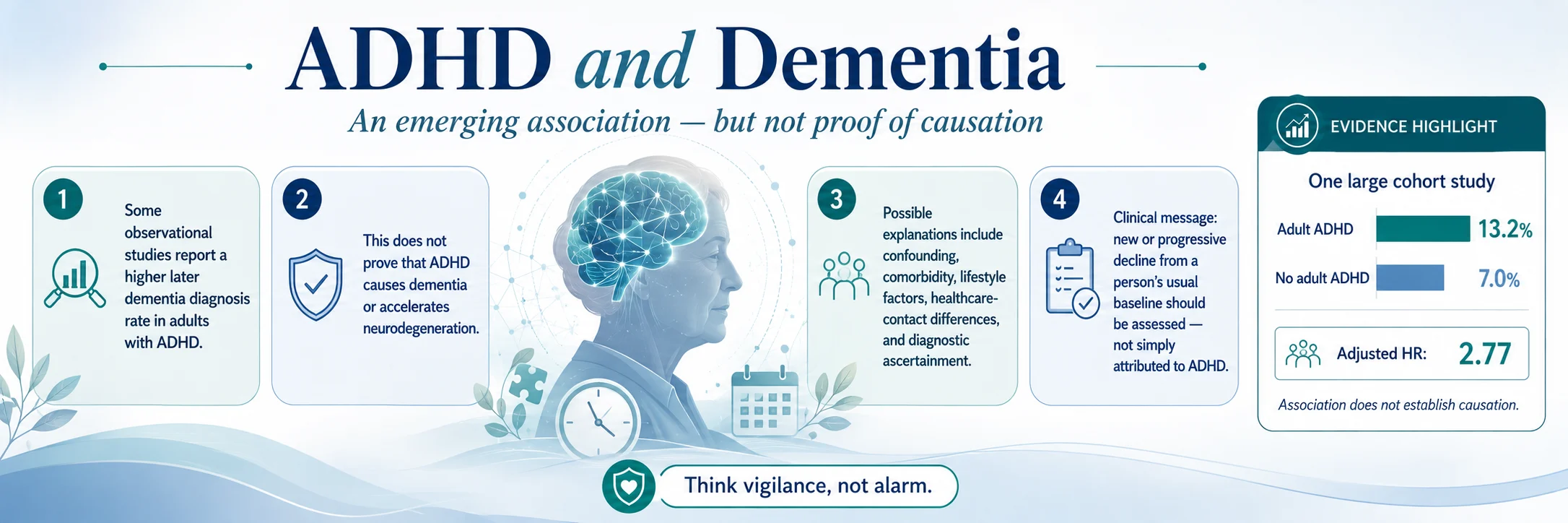
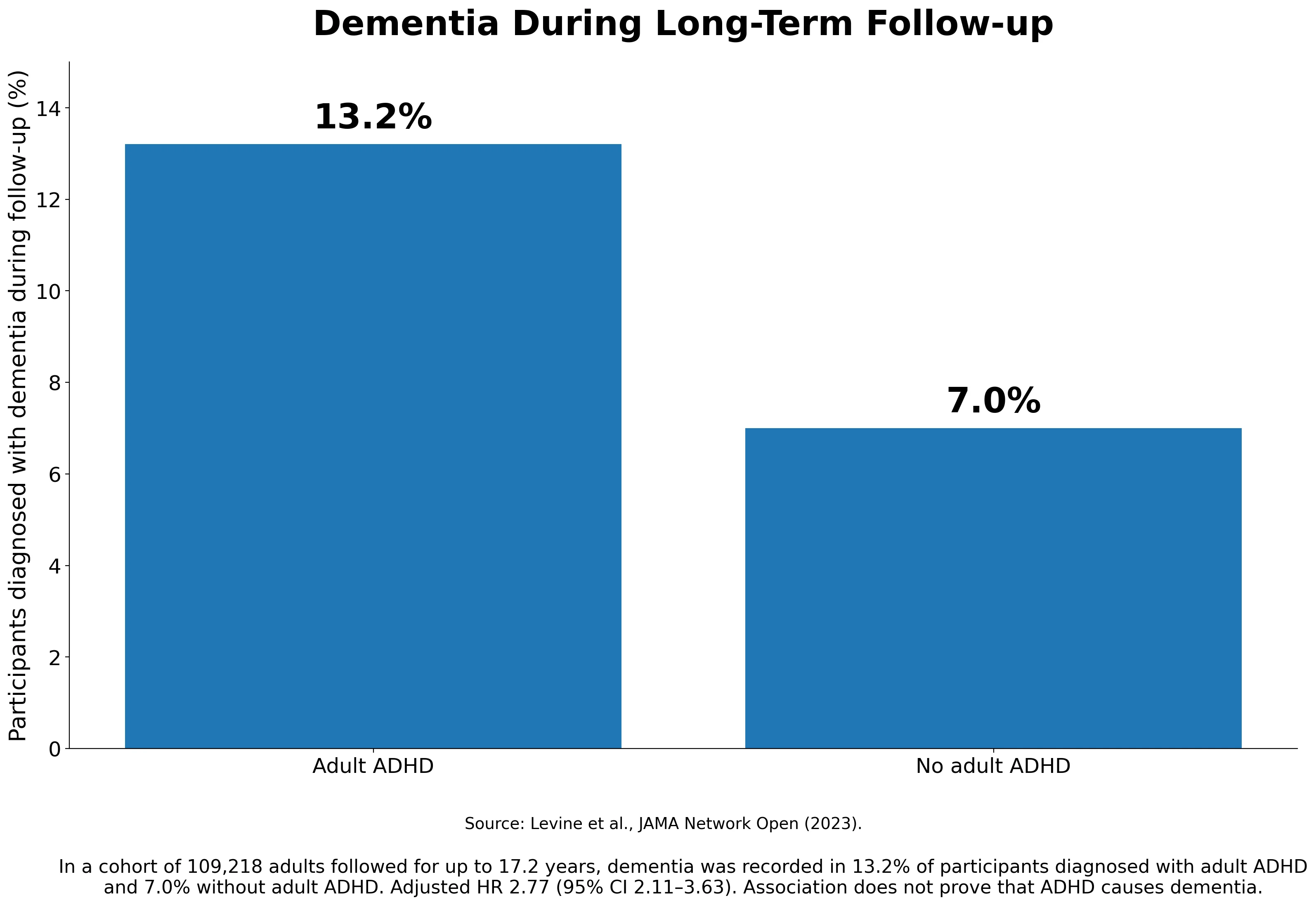
Some observational research has reported an association between ADHD in adulthood and a higher subsequent rate of dementia diagnosis. In one large cohort study of more than 100,000 adults, dementia was recorded more frequently during follow-up in people diagnosed with adult ADHD than in those without ADHD. However, this does not establish that ADHD causes dementia, accelerates neurodegeneration or inevitably increases an individual’s risk of developing dementia. Observational findings can be influenced by residual confounding, differences in healthcare contact, cardiovascular and psychiatric comorbidity, lifestyle factors and diagnostic ascertainment. The clinically important message is therefore one of vigilance rather than alarm: in an older person with established ADHD, a new or progressive change from their longstanding cognitive and functional baseline should not simply be attributed to ADHD and may require assessment for mild cognitive impairment, dementia or another neurological or medical cause.
3. Diagnostic assessment in older adults
The diagnosis remains a clinical diagnosis. There is no validated blood test, brain scan, EEG pattern or genetic test that independently establishes ADHD in an individual. Rating scales can support assessment but do not replace it.
- Developmental history: Establish evidence of symptoms before age 12 and a broader lifelong pattern. School reports, childhood descriptions, occupational history and collateral accounts can be particularly valuable when direct recall is limited.
- Current symptoms and impairment: Assess symptom persistence and clinically significant impairment across relevant settings. Later-life domains may include medication management, appointments, finances, home organisation, driving, relationships and maintaining independence.
- Differential diagnosis: Review mood, anxiety, sleep, substance use, medication effects, pain, endocrine/metabolic causes, sensory impairment, neurological disease and possible neurocognitive disorder.
- Physical and medication review: Polypharmacy can worsen attention, sedation, orthostasis or sleep. A full medication review is therefore more important in later life than merely documenting ADHD medication contraindications.
- Cognitive testing: Neuropsychological testing is not required to diagnose ADHD, but can be useful where cognitive decline, learning disorder or another neurological condition is suspected. Interpretation must remain clinical because no cognitive profile is diagnostic of ADHD.
- Screening instruments: ASRS and other adult scales may be useful as structured symptom prompts, but most were not specifically developed or validated for people over 65; cut-offs should therefore be interpreted cautiously.
4. Why ADHD is often missed in later life
Many older adults grew up when ADHD was poorly recognised outside disruptive childhood presentations. Predominantly inattentive symptoms, high academic ability, strong family structure or intense compensatory effort may have delayed recognition for decades.
- Late diagnosis can trigger both relief and grief: a new explanatory framework for longstanding difficulties may coexist with regret about education, work, relationships or self-concept. This is clinically relevant and should be acknowledged rather than treating diagnosis as a purely technical event.
Women may be especially likely to have been missed historically because inattentive and internalised presentations attracted less attention. Menopause and other hormonal transitions may alter perceived symptom burden in some women, but this area remains under-researched and should not be used as a substitute for standard diagnostic criteria.
Depression, anxiety, bereavement, sleep disturbance, chronic pain, sensory impairment and physical illness can obscure ADHD or mimic it. The correct approach is formulation, not diagnostic substitution.
5. Comorbidity and functional impact
The limited later-life literature reports substantial psychiatric and functional burden, particularly depression, anxiety, relationship difficulties and social isolation. Assessment should focus on real-world consequences rather than symptom counts alone.
|
Area |
Examples to assess |
|
Daily administration |
appointments, bills, pensions, insurance, correspondence, online accounts |
|
Health management |
medication adherence, monitoring, multiple appointments, dietary or rehabilitation plans |
|
Safety |
driving, distraction, impulsive decisions, falls risk where medication or orthostasis is relevant |
|
Home and independence |
household tasks, shopping, routines, managing possessions, maintaining a safe environment |
|
Relationships |
interrupting, forgetfulness, emotional reactivity, conflict, caregiver dynamics |
|
Wellbeing |
sleep, loneliness, social isolation, loss of role after retirement, self-esteem |
6. Medication in later life
Age alone is not an automatic contraindication. However, people aged 60–65+ are under-represented in ADHD medication trials, while cardiovascular disease, polypharmacy, weight loss, sleep disturbance and frailty become more common. Prescribing therefore requires individualised risk–benefit assessment and careful monitoring.
|
Cardiovascular evidence caution. A large observational cohort of adults aged 66+ found a higher rate of cardiovascular events shortly after stimulant initiation, with the association attenuating over time. This does not establish that stimulants are inappropriate in older adults, but it supports careful patient selection, baseline assessment and vigilance around initiation and dose change. |
NICE-aligned adult medication sequence
|
Option |
Role in adults |
Later-life considerations |
|
Lisdexamfetamine / methylphenidate |
NICE first-line pharmacological treatments for adults. |
Check cardiovascular history/status, pulse/BP, sleep, appetite/weight, psychiatric state, interactions and misuse/diversion risk. Titrate cautiously where comorbidity or frailty increases risk. |
|
Dexamfetamine |
May be considered when lisdexamfetamine is effective but the longer effect profile is not tolerated. |
Shorter duration can sometimes aid tailoring, but the same stimulant safety considerations apply. |
|
Atomoxetine |
NICE adult non-stimulant option when stimulants are not tolerated or have not produced adequate response. |
Not automatically “cardiovascularly safer”; it can increase heart rate and blood pressure and may have drug–drug interaction considerations. |
|
Guanfacine |
Not a routine NICE adult option; adult use is off-label and NICE advises tertiary specialist input. |
Can cause hypotension, orthostatic symptoms, dizziness and syncope—important in people at risk of falls or taking antihypertensives. |
Baseline and ongoing monitoring
- Before medication: confirm ongoing ADHD and treatment need; review mental health and social circumstances; document medical history and current medication; record weight, pulse and blood pressure; perform a cardiovascular assessment.
- Routine ECG is not required solely because a stimulant, atomoxetine or guanfacine is being prescribed when cardiovascular history and examination are reassuring and there is no relevant interacting cardiac-risk medication. Obtain ECG/cardiology assessment when clinically indicated.
- During titration: monitor effectiveness and adverse effects, and check pulse and blood pressure before and after each dose change.
- Once stable: NICE recommends pulse and blood pressure at least every six months, and adult weight every six months; monitor BMI if treatment-related weight change persists.
- In older adults with cardiovascular disease, multimorbidity, frailty or significant polypharmacy, a slower titration and closer monitoring schedule may be clinically appropriate even when not mandated solely by age.
7. Psychological, environmental and practical treatment
Medication is only one component of management. Later-life treatment often works best when executive demands are reduced and useful routines are made visible, simple and repeatable.
|
Environmental modification |
reduce unnecessary administrative complexity; keep essential items in fixed locations; simplify recurring tasks and decision points |
|
External memory |
large visible calendars, written checklists, repeated reminders, voice assistants, medication prompts and appointment alerts |
|
Financial systems |
direct debits, banking alerts, simplified accounts and trusted support where the person chooses it |
|
ADHD-focused psychological work |
planning, procrastination, emotional regulation, problem solving, self-understanding and realistic compensatory strategies |
|
Sleep and physical health |
identify sleep disorders, pain, sensory impairment and medical factors that worsen concentration or fatigue |
|
Occupational therapy |
useful where ADHD interacts with mobility, disability, home safety or maintaining independence |
|
Social connection |
structured activities, peer support and meaningful roles can reduce isolation after retirement or bereavement |
8. Family, partners and carers
With consent, relatives or long-term partners can contribute valuable evidence about both developmental history and current functioning.
Psychoeducation can help families understand that forgetfulness, interrupting, losing objects or incomplete tasks may reflect ADHD rather than deliberate inconsideration. At the same time, not every difficulty should be attributed to ADHD.
The older adult’s autonomy remains central. Support should be proportionate and collaborative rather than automatically transferring control of finances, medication or daily decisions to relatives or carers.
9. What we still do not know
ADHD in later life remains one of the least researched parts of the lifespan. Important unanswered questions include:
- the true prevalence of clinically impairing ADHD beyond age 65
- whether age-adjusted symptom thresholds would improve diagnostic validity
- the best way to distinguish longstanding ADHD from MCI and early dementia
- long-term effectiveness and safety of ADHD medication in people aged 60–80+
- how frailty, cardiovascular disease and polypharmacy modify treatment risk
- how menopause and other hormonal transitions affect later-life symptom burden
- the interaction between ADHD, vascular risk and neurodegenerative disorders
Current evidence supports neither age-based dismissal nor diagnostic over-attribution. The most defensible approach is lifespan-informed assessment, explicit differential diagnosis, functional formulation and individualised treatment.
10. A concise clinical framework
|
Ask |
Why it matters |
|
Were relevant symptoms present in childhood? |
Required for a neurodevelopmental ADHD diagnosis; late-onset cognitive symptoms need another explanation. |
|
Has the person always functioned this way, or is there a clear decline? |
Trajectory is central to distinguishing ADHD from neurocognitive disorder. |
|
What changed around retirement, illness or bereavement? |
Loss of scaffolding can expose longstanding ADHD without representing neurodegeneration. |
|
Are there red flags for neurological or medical disease? |
Prevents diagnostic overshadowing. |
|
What medications and substances could affect cognition, BP, pulse, sleep or falls? |
Polypharmacy and physiological vulnerability are more common in later life. |
|
What is the actual functional impairment? |
Treatment should target meaningful problems, not questionnaire scores. |
|
What does the person want treatment to improve? |
Supports proportionate, person-centred risk–benefit decisions. |
Key message
|
ADHD can persist throughout the entire lifespan. Later life may make previously compensated ADHD more visible, especially when routine, work structure or physical reserve changes. A late diagnosis can be meaningful and clinically useful. But new or progressive cognitive decline is a different clinical phenomenon. Age should not exclude ADHD from consideration—and ADHD should not be used to explain away neurological, medical or neurocognitive change. |
Useful resources
|
Resource |
Best use |
Website |
|
NICE – Attention deficit hyperactivity disorder: diagnosis and management (NG87) |
Primary UK clinical guidance for assessment, medication choice, baseline physical review and monitoring. |
https://www.nice.org.uk/guidance/ng87 |
|
NHS – ADHD in adults |
Accessible overview of symptoms, assessment and treatment in adults. |
https://www.nhs.uk/conditions/adhd-adults/ |
|
ADHD Foundation Neurodiversity Charity |
UK psychoeducation, practical resources and support. |
https://www.adhdfoundation.org.uk/ |
|
ADHD UK |
UK charity providing information, advocacy, support groups and service-navigation resources. |
https://adhduk.co.uk/ |
|
CHADD |
Large international ADHD organisation with evidence-informed lifespan resources. |
https://chadd.org/ |
|
Alzheimer’s Society |
Useful when new memory or cognitive concerns raise questions about MCI or dementia. |
https://www.alzheimers.org.uk/ |
|
Age UK |
Practical later-life support on money, benefits, loneliness, technology, caring and independence. |
https://www.ageuk.org.uk/ |
|
WHO Adult ADHD Self-Report Scale (ASRS) information |
Screening support only; not a diagnostic test and not specifically validated for older adults. |
https://www.hcp.med.harvard.edu/ncs/asrs.php |
Selected references and guidance
- Kooij JJS, et al. The diagnosis and treatment of attention-deficit hyperactivity disorder (ADHD) in older adults. Expert Review of Neurotherapeutics. 2023. PMID: 37725058. doi:10.1080/14737175.2023.2250913.
- Dobrosavljevic M, et al. ADHD in older adults – a scoping review. Aging & Mental Health. 2024. PMID: 38622905. doi:10.1080/13607863.2024.2339994.
- Tadrous M, et al. Assessment of stimulant use and cardiovascular event risks among older adults. JAMA Network Open. 2021;4(10):e2130795. doi:10.1001/jamanetworkopen.2021.30795.
- NICE. Attention deficit hyperactivity disorder: diagnosis and management. NICE guideline NG87. Published 2018; last substantive update 2019, with subsequent minor amendments including 2025 diagnostics-link update.
- Sibley MH, et al. Is ADHD a valid diagnosis in older adults? Clinical Psychology Review. 2017;52:197–204. PMID: 28124223.
- Michielsen M, et al. ADHD in old age: a review of the literature and proposal for assessment and treatment. Expert Review of Neurotherapeutics. 2016;16(12):1371–1381. PMID: 27334252.