
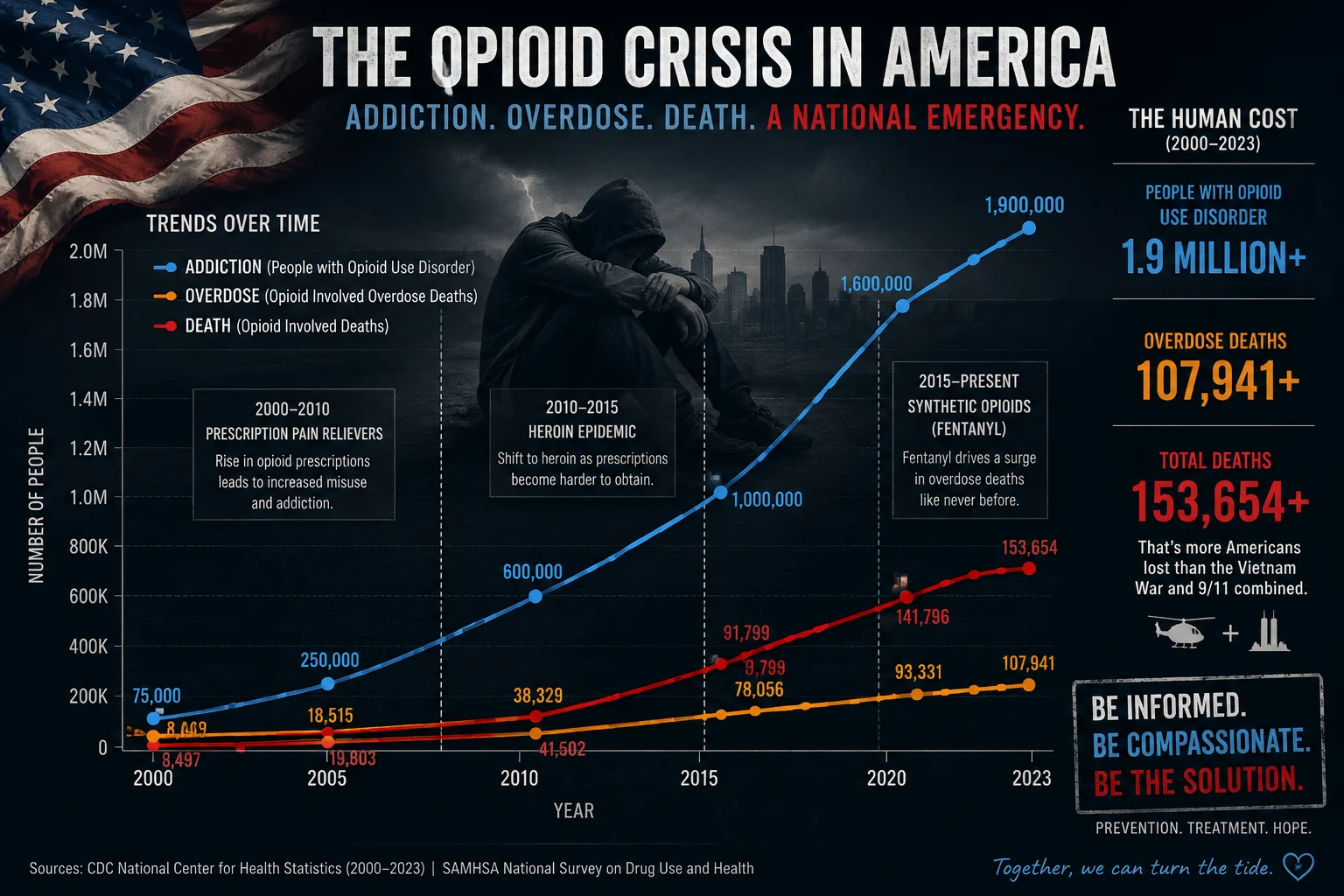
THE USA
OPIOID CRISIS
How pain treatment, prescribing, heroin, fentanyl and a changing synthetic-drug market created one of America’s defining public-health emergencies
- A current 2026 review: history • epidemiology • treatment • harm reduction • policy • emerging risks
|
2026 SNAPSHOT |
|
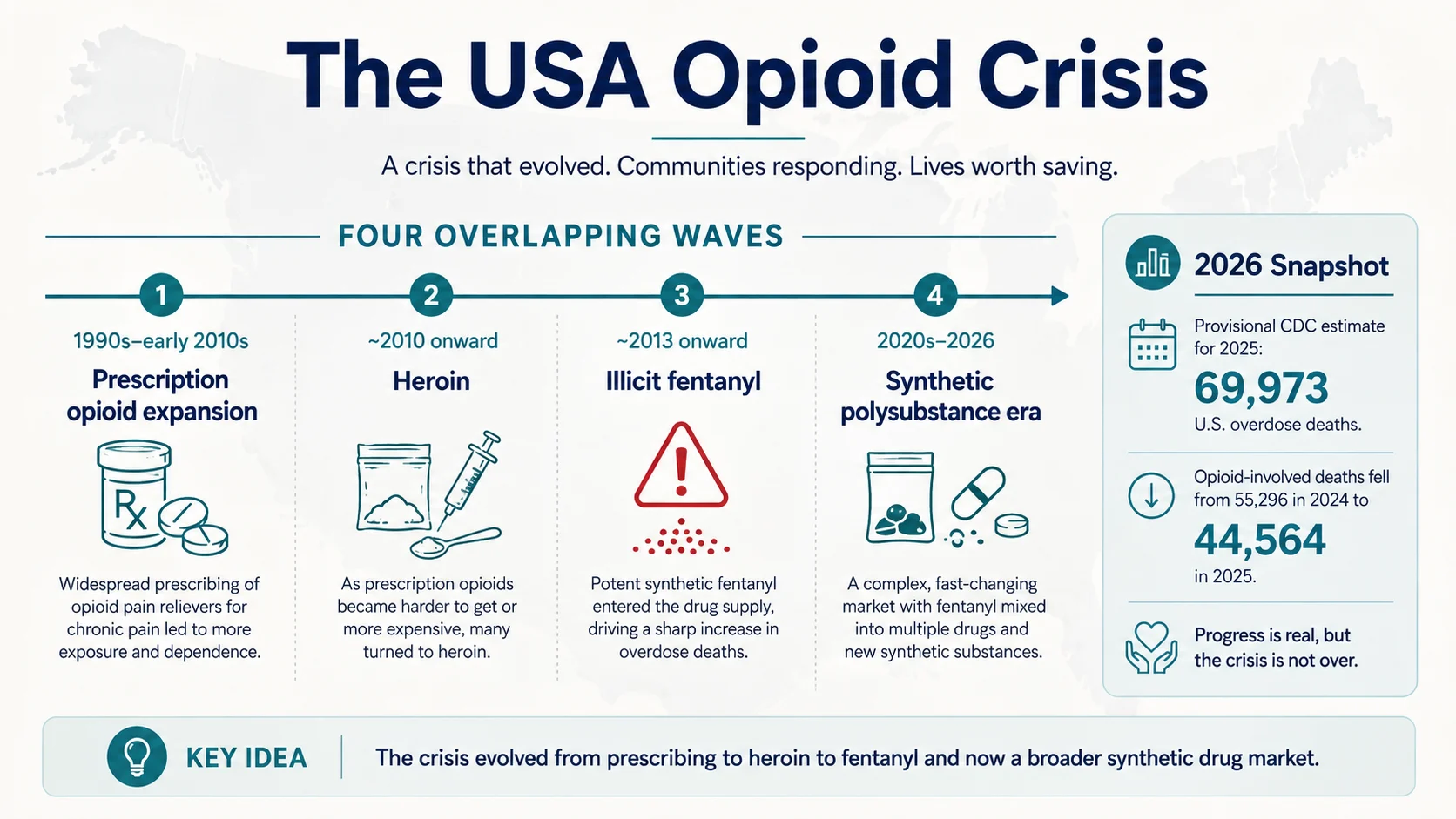
The crisis is changing, not over. Provisional CDC data estimate about 69,973 US drug-overdose deaths in 2025, down almost 14% from 2024. Opioid-involved deaths were estimated to fall from about 55,296 in 2024 to 44,564 in 2025. This is substantial progress, but mortality remains extraordinarily high and the illicit supply is increasingly polysubstance, synthetic and unpredictable.[1] |
Overview
The American opioid crisis is often described as a single epidemic, but it is better understood as a sequence of overlapping epidemics. The first was driven largely by expanded prescribing of opioid analgesics. The second saw a sharp rise in heroin use and heroin-related mortality. The third was dominated by illicitly manufactured fentanyl and analogues. A fourth, more complex phase is now emerging in which fentanyl is embedded in a wider polysubstance market involving cocaine, methamphetamine, counterfeit tablets and non-opioid adulterants such as xylazine and medetomidine.
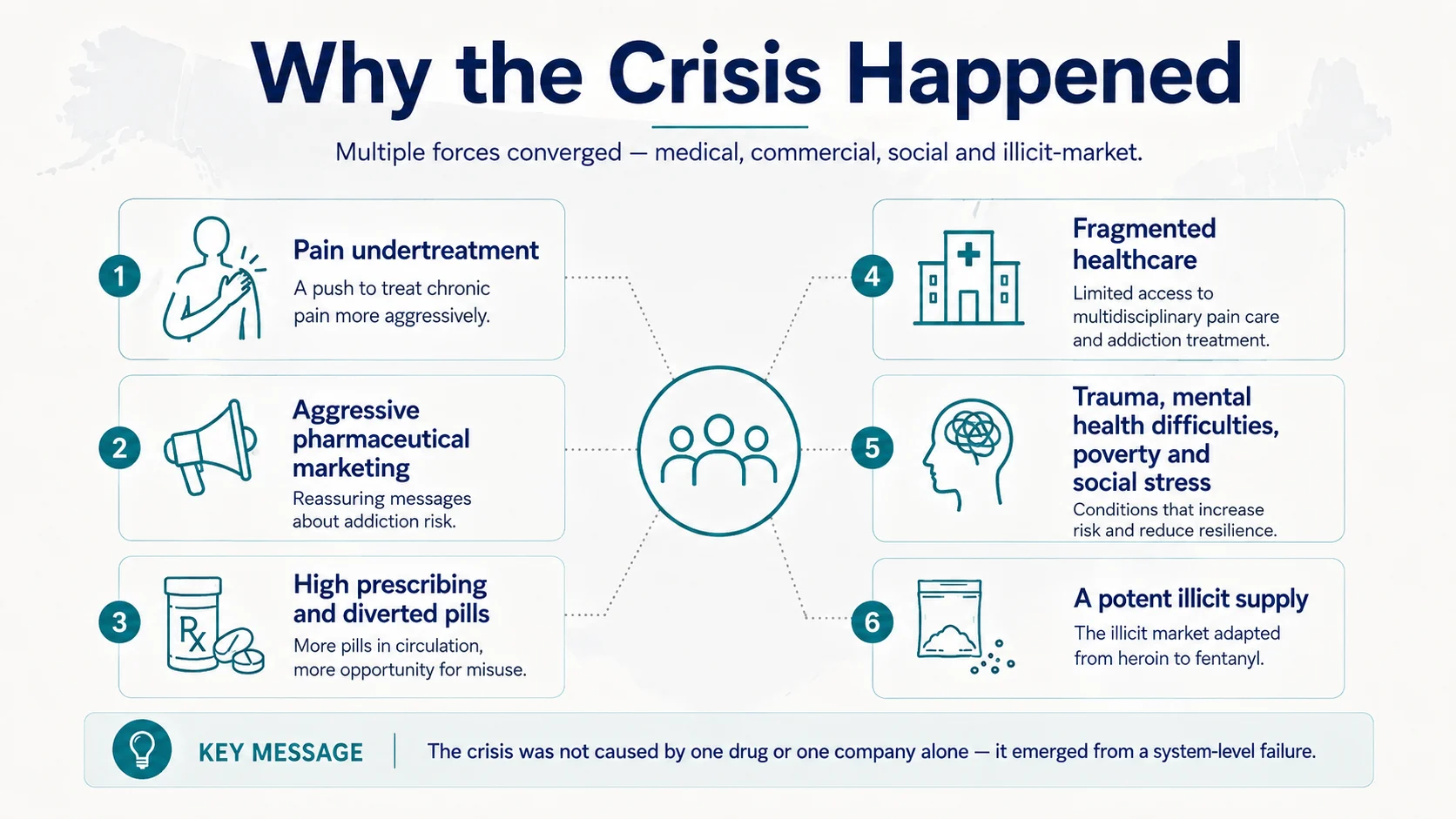
The central lesson is that the crisis cannot be explained by one drug, one company, one prescribing guideline or one social problem. It arose from the interaction of legitimate undertreatment of pain, aggressive pharmaceutical marketing, permissive prescribing cultures, fragmented healthcare, economic and social vulnerability, addiction biology, illicit-market adaptation, stigma, treatment barriers and an exceptionally potent synthetic drug supply.
Current thinking has therefore moved beyond a narrow 'reduce prescriptions' model. Modern policy increasingly combines safer pain care, evidence-based treatment of opioid use disorder (OUD), naloxone availability, harm reduction, infectious-disease prevention, recovery support, housing and social interventions, and drug-supply surveillance. At the same time, clinicians are warned not to respond to the earlier overprescribing era with abrupt or non-consensual opioid withdrawal from people with chronic pain. The CDC’s current prescribing guidance explicitly rejects rigid dose thresholds and emphasises individualized clinical judgment.[2]
|
Terminology matters |
|
‘Opioid’ includes natural, semi-synthetic and synthetic drugs acting at opioid receptors: morphine, codeine, oxycodone, hydrocodone, heroin, fentanyl, methadone and others. ‘Opiate’ is narrower and traditionally refers to drugs derived directly from opium. In modern US public-health writing, ‘opioid crisis’ is the more accurate term. |
The crisis in one table
|
Phase |
Approximate period |
Main driver |
Key feature |
|
Wave 1 |
1990s–early 2010s |
Prescription opioid expansion |
Oxycodone, hydrocodone and other prescribed opioids; rising dependence and overdose. |
|
Wave 2 |
~2010 onward |
Heroin |
Cheaper and more available illicit opioid supply; increasing heroin-related deaths. |
|
Wave 3 |
~2013 onward |
Illicit fentanyl |
Very high potency, rapid onset and contamination of heroin/counterfeit pills. |
|
Current phase |
2020s–2026 |
Synthetic polysubstance market |
Fentanyl plus stimulants, counterfeit medicines and sedative adulterants; highly variable regional patterns. |
1. Before the epidemic: opioids, pain and American medicine
Opioids have been used medically for centuries. Morphine transformed the treatment of severe pain in the nineteenth century; heroin was later introduced commercially before its addictive potential became fully appreciated. By the late twentieth century, opioids remained indispensable for anaesthesia, acute severe pain, trauma, postoperative pain, palliative care and cancer pain. The controversy that followed was therefore never about whether opioids have legitimate medical value. It concerned how broadly, how long and at what doses they should be used for chronic non-cancer pain, and how risks should be monitored.
During the 1980s and 1990s, clinicians and patient advocates increasingly argued that pain was undertreated. This was a real clinical problem. Pain became framed in some settings as the 'fifth vital sign', and professional statements supported more assertive treatment of chronic pain. The National Academies later described how these developments coincided with growing use of opioids for chronic non-cancer pain.[3]
This change occurred within a healthcare system that often rewarded rapid pharmacological solutions more readily than lengthy multidisciplinary pain care. Physical therapy, psychological treatments, rehabilitation and specialist pain services could be difficult to access or poorly reimbursed, whereas prescribing a medicine was immediate.
2. OxyContin and the prescribing boom
OxyContin, a controlled-release formulation of oxycodone, was approved by the US Food and Drug Administration in 1995 and launched in 1996. It became emblematic of the prescription-opioid era because it combined a potent opioid with extensive promotion to clinicians. Purdue Pharma and other opioid manufacturers were later accused in litigation and government actions of misleading or overly reassuring promotion concerning addiction risk and appropriate use.
The broader problem, however, extended beyond one product. Prescribing of hydrocodone, oxycodone and other opioids increased dramatically across the United States. Large quantities of tablets entered communities, creating exposure not only among patients but through diversion to relatives, friends, informal markets and so-called 'pill mills'. For some people, long-term medical exposure produced tolerance, physical dependence or OUD; for others, recreational use began with diverted tablets.
Between 1999 and 2011, US deaths involving prescription opioids rose markedly. The National Academies described a tripling of annual prescription-opioid overdose deaths over that period.[4] Prescription monitoring programmes, law-enforcement action against pill mills, reformulated products and changes in prescribing later reduced access to many prescription opioids. These measures were necessary, but the illicit market adapted.
|
Dependence is not the same as addiction |
|
Physical dependence can occur during appropriate long-term opioid treatment and means that withdrawal symptoms may occur if the drug is stopped abruptly. Tolerance means that effects may diminish with repeated exposure. Opioid use disorder is a behavioural and clinical syndrome involving impaired control, craving, continued use despite harm and other DSM-5 features. Conflating these concepts can stigmatise legitimate pain patients and can lead to unsafe tapering. |
3. The shift to heroin
From around 2010, heroin-related mortality rose sharply. Heroin was often cheaper per opioid-equivalent effect than diverted prescription tablets and was readily available in many regions. Some people who had developed OUD through prescription opioids transitioned to heroin, although it is important not to imply that everyone prescribed an opioid progresses to heroin; the great majority do not.
- This transition demonstrated a recurring feature of drug policy: reducing the availability of one source without simultaneously expanding treatment and addressing demand can cause the market to move rather than disappear. The heroin phase also increased risks associated with injection, including HIV, hepatitis C, bacterial infections and endocarditis.
4. Fentanyl changes the mathematics of overdose
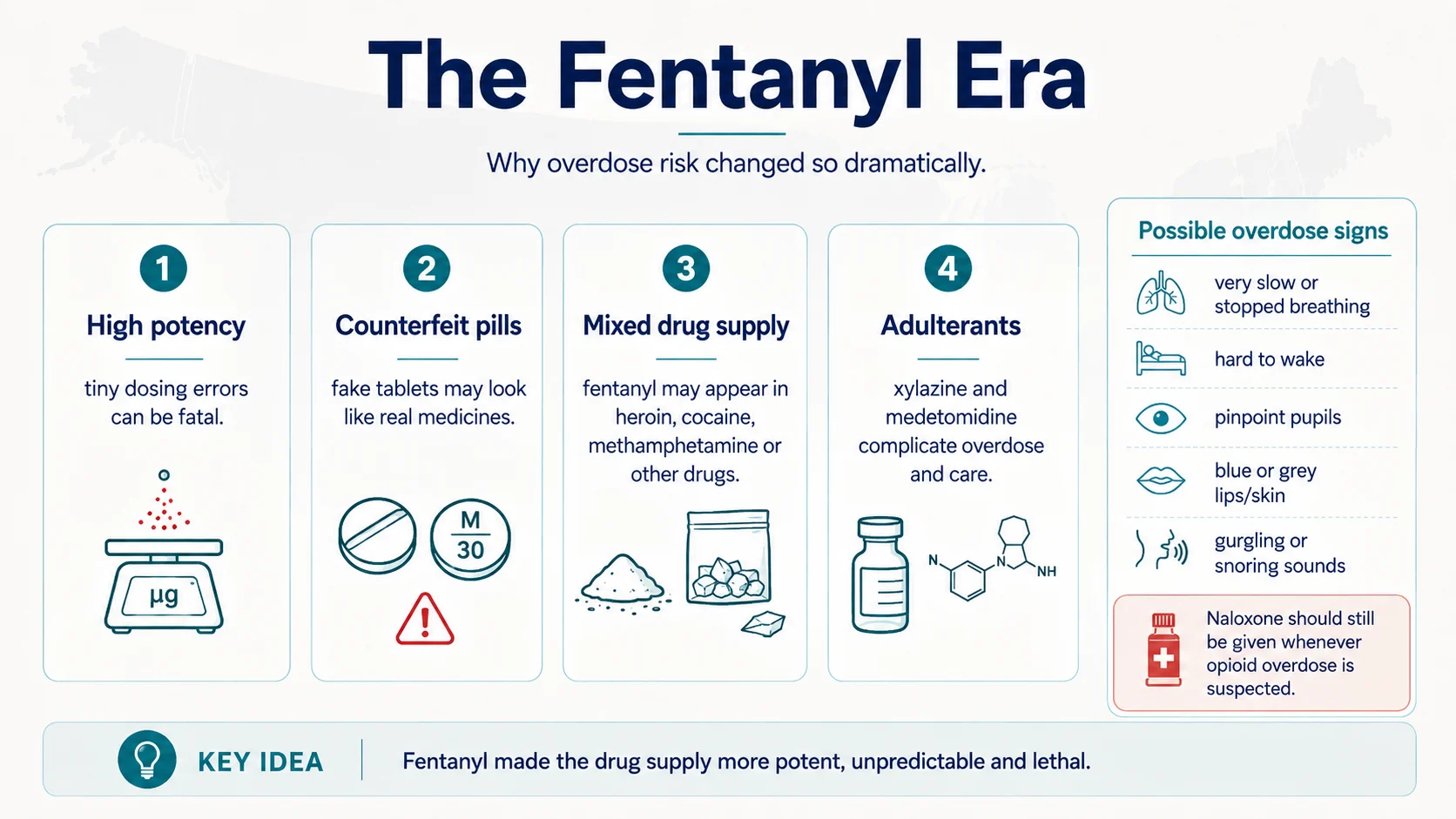
The most consequential change came with illicitly manufactured fentanyl. Pharmaceutical fentanyl has legitimate uses in anaesthesia and severe pain, but the fentanyl driving US overdose mortality is predominantly illicitly manufactured. It is highly potent, acts rapidly and can be produced synthetically without cultivating opium poppies. Small quantities can therefore supply very large numbers of doses.
From roughly 2013 onward, fentanyl increasingly entered heroin markets and later counterfeit tablets made to resemble oxycodone, hydrocodone, alprazolam and other medicines. It also became detectable in stimulant supplies. A person may therefore consume fentanyl unintentionally, and a counterfeit tablet that visually resembles a pharmaceutical product can contain a dangerous and inconsistent amount.
NIDA notes that illicit fentanyl and other potent synthetic opioids account for the vast majority of opioid overdose deaths in recent years.[5] High potency is only part of the danger: dose inconsistency, rapid respiratory depression, reduced tolerance after abstinence, use alone, concurrent benzodiazepines or alcohol, and delayed emergency response all increase lethality.
5. A fourth wave: fentanyl plus stimulants and adulterants
The present US overdose environment is increasingly polysubstance. Death certificates frequently identify more than one drug, and fentanyl may appear alongside cocaine or methamphetamine. This does not necessarily mean that users intentionally sought an opioid-stimulant combination; contamination, shared supply chains and counterfeit products complicate interpretation.
Xylazine, a veterinary sedative, has become an important adulterant in some fentanyl markets. It is not an opioid, so naloxone does not reverse xylazine itself, although naloxone should still be given whenever opioid poisoning is possible because fentanyl is commonly present. Xylazine exposure is associated with profound sedation and severe skin and soft-tissue injury. The DEA’s 2025 assessment reported xylazine in seized drug samples across every US state, as well as the District of Columbia and Puerto Rico, and highlighted the emergence of the more potent veterinary sedative medetomidine in the fentanyl supply.[6]
This is why the term 'opioid crisis' is still useful but incomplete. The current emergency is increasingly a synthetic-drug and polysubstance crisis in which fentanyl remains the dominant lethal ingredient.
6. Where the numbers stand in 2026
The most encouraging recent development is a large fall in overdose mortality. CDC provisional estimates released in May 2026 indicate about 69,973 US drug-overdose deaths during 2025, almost 14% fewer than the estimated 81,313 in 2024. Estimated opioid-involved deaths fell from about 55,296 in 2024 to 44,564 in 2025.[1]
This follows an even larger provisional decline reported for 2024 compared with 2023. The direction of travel is therefore important and appears sustained nationally, although the decline is not uniform: some states have continued to experience increases, and provisional figures remain subject to revision.[1,7]
The reasons for the decline are likely to be multiple rather than attributable to a single intervention. Plausible contributors include wider naloxone distribution, expanded treatment with buprenorphine and methadone, changes in fentanyl supply and potency, greater public awareness, reduced prescription exposure, harm-reduction services, improved emergency response, and population-level changes among people at highest risk. It remains too early to know the relative contribution of each factor.
7. Why the United States was particularly vulnerable
|
Contributing factor |
How it mattered |
|
High opioid exposure |
Historically high prescribing created a large population exposed to potent opioid analgesics and increased availability for diversion. |
|
Commercial incentives |
Aggressive pharmaceutical promotion and fragmented accountability influenced clinical culture. |
|
Fragmented healthcare |
Addiction, mental health, pain medicine and primary care often functioned in separate systems. |
|
Limited treatment access |
Methadone regulation, stigma, clinician shortages, insurance barriers and geography restricted OUD treatment. |
|
Social determinants |
Poverty, unemployment, housing instability, trauma, incarceration and social disconnection increase vulnerability and worsen outcomes. |
|
Potent illicit supply |
Fentanyl makes small errors in dose, relapse or unexpected exposure much more likely to become fatal. |
|
Polysubstance use |
Alcohol, benzodiazepines and sedatives worsen respiratory depression; stimulant use can conceal sedation until opioid effects dominate. |
8. Opioid use disorder: the modern clinical model
Current addiction medicine treats OUD as a chronic, relapsing but highly treatable disorder rather than a failure of willpower. Repeated opioid exposure alters reward, stress and learning systems; tolerance and withdrawal can drive continued use, while conditioned cues and craving persist after detoxification. Risk is further shaped by trauma, psychiatric comorbidity, pain, social context and drug availability.
Detoxification alone is not considered adequate treatment for most people with moderate or severe OUD because loss of tolerance can make relapse particularly dangerous. The strongest evidence supports ongoing medication treatment, especially with methadone or buprenorphine, combined with psychosocial and practical support according to individual need.
9. Medications for opioid use disorder (MOUD)
|
Medication |
Mechanism |
Strengths |
Important considerations |
|
Methadone |
Full μ-opioid agonist |
Strong evidence for retention and mortality reduction; suppresses withdrawal/craving. |
In the US, OUD treatment is generally delivered through regulated opioid treatment programmes; careful dosing and interaction review required. |
|
Buprenorphine |
High-affinity partial μ-opioid agonist |
Effective, safer respiratory profile than full agonists; can be prescribed in office/community settings. |
Fentanyl can complicate conventional induction; low-dose/micro-induction strategies are increasingly used in selected settings. |
|
Extended-release naltrexone |
Opioid antagonist |
No opioid agonist effect; monthly injection; useful for some highly motivated patients. |
Requires an opioid-free period before initiation, creating a practical barrier and risk of precipitated withdrawal if started too soon. |
SAMHSA continues to identify methadone, buprenorphine and naltrexone as the three FDA-approved medication approaches for OUD.[8] Federal policy has also reduced barriers to buprenorphine: the former DATA 2000 'X-waiver' requirement was removed in 2022, allowing appropriately registered prescribers to treat OUD without the previous waiver system.[9]
The terminology has also evolved. 'Medications for opioid use disorder' is increasingly preferred to 'medication-assisted treatment' because medication is not merely an adjunct to counselling; for many patients it is the core evidence-based treatment.[10]
10. Fentanyl-era treatment: what has changed?
Fentanyl presents practical treatment challenges. Its high receptor affinity, frequent use and tissue redistribution can make the timing of standard buprenorphine induction less predictable, creating concern about precipitated withdrawal. Clinicians increasingly use individualized approaches, including waiting for sufficiently objective withdrawal, higher-dose emergency-department induction in selected patients, or low-dose overlap ('micro-induction') strategies. Practice varies and evidence continues to develop.
The key modern principle is rapid access. A person who requests treatment after an overdose, emergency-department visit or period of withdrawal is at exceptionally high risk, and delays caused by referral chains, mandatory counselling requirements or administrative barriers can be fatal.
11. Naloxone and overdose prevention
Naloxone is a competitive opioid antagonist that can rapidly reverse opioid-induced respiratory depression. Wider distribution to people who use drugs, families, friends, first responders, libraries, schools and community organisations has become one of the most visible responses to the epidemic. Because fentanyl is potent, repeated naloxone dosing may be required, and emergency medical help remains important.
|
Recognising a possible opioid overdose |
|
Typical warning signs include inability to wake, very slow or absent breathing, pinpoint pupils, blue/grey lips or skin, snoring or gurgling respirations and limpness. Give naloxone if available, call emergency services, support breathing and repeat naloxone according to the product instructions if there is inadequate response. Naloxone will not harm someone merely because the event turns out not to be opioid-related. |
12. Harm reduction: a major shift in US thinking
Harm reduction accepts that some people will continue to use drugs and seeks to keep them alive and healthier while maintaining pathways into treatment. This is not the same as approving of drug use. It is a pragmatic public-health strategy based on the observation that dead patients cannot recover.
· Naloxone distribution and overdose-response training.
· Syringe-service programmes to reduce HIV, hepatitis C and bacterial infections.
· Fentanyl test strips and other drug-checking approaches where legally available.
· Education about avoiding use alone, testing small amounts, reduced tolerance after abstinence, and the risks of combining opioids with alcohol, benzodiazepines or other sedatives.
· Wound care and outreach for people exposed to xylazine-adulterated supplies.
· Low-threshold access to buprenorphine, methadone and recovery support.
13. Pain care after the pendulum swing
One of the most important corrections in current thinking is recognition that the response to overprescribing can itself cause harm if applied rigidly. After the 2016 CDC guideline, some health systems, insurers and clinicians interpreted dosage thresholds as hard limits. Patients who had been stable for years on opioid therapy sometimes experienced forced or rapid tapers, loss of care or severe deterioration.
- The CDC’s 2022 guideline was deliberately more explicit: dosage figures are guideposts, not inflexible standards; clinicians should individualize care; and long-term opioids should generally not be stopped abruptly unless there is an immediate life-threatening concern.[2] The contemporary position is therefore balanced: avoid unnecessary opioid initiation and dose escalation, use non-opioid and non-pharmacological treatments where effective, monitor risk, co-prescribe naloxone when appropriate, but do not abandon people with chronic pain.
14. The role of mental health, trauma and neurodevelopment
OUD rarely exists in isolation. Depression, anxiety, post-traumatic stress, chronic pain, attention-deficit/hyperactivity disorder, personality vulnerability, sleep disturbance and other substance-use disorders may coexist and can influence both initiation and relapse. Integrated treatment is preferable to serial referral between disconnected services.
ADHD is particularly relevant because impulsivity, reward dysregulation, emotional dysregulation and elevated rates of other substance use can increase vulnerability to substance-use disorders. This does not mean stimulant treatment causes the opioid crisis; appropriately diagnosed and monitored ADHD treatment should be considered on its own evidence and risk-benefit profile.
15. Inequality and geography
The epidemic has changed demographically over time. Early public narratives focused heavily on white rural and post-industrial communities, but fentanyl-era mortality affects urban, suburban, rural, Black, Hispanic, American Indian/Alaska Native and other populations. Rates and drug combinations vary substantially by region. CDC research has documented particularly severe fentanyl-related impacts in some American Indian and Alaska Native populations.[11]
- Structural factors matter: unstable housing, lack of transport, incarceration, lack of insurance continuity, stigma and limited availability of opioid-treatment programmes can all interrupt care. People leaving prison or residential treatment are at especially high overdose risk because tolerance has fallen while the illicit supply may be more potent than before.
16. Criminal justice versus public health
The United States has historically relied heavily on prohibition and criminal enforcement. Supply disruption can reduce availability and is part of national policy, but the fentanyl era has exposed the limits of enforcement as a standalone strategy. Synthetic opioids are compact, highly potent and adaptable; removing one supplier or precursor route can shift production elsewhere.
Contemporary policy debates therefore centre on how to combine law enforcement against trafficking with public-health measures that reduce demand and mortality. Drug courts, diversion to treatment, treatment in prisons and jails, continuity of methadone or buprenorphine during incarceration, and rapid post-release linkage are increasingly viewed as critical.
17. What may be driving the recent fall in deaths?
The 2024–2025 decline is one of the most important developments since the crisis began. It should be interpreted cautiously. National mortality statistics lag, provisional estimates are revised, and state trends differ. Nevertheless, several factors may be working in the same direction.
· Naloxone is far more available than a decade ago, including through community distribution and over-the-counter access.
· More clinicians and services can prescribe buprenorphine after removal of the federal X-waiver.
· Methadone and opioid-treatment programme rules have become more flexible, including greater use of take-home doses and telehealth in appropriate circumstances.
· Public awareness of fentanyl and counterfeit tablets is higher.
· Some areas have developed mature harm-reduction networks and rapid post-overdose outreach.
· The illicit market itself may be changing in potency, composition or user population.
No single explanation has yet been established, and it would be premature to declare the epidemic solved. Even the improved 2025 estimate represents roughly seventy thousand drug-overdose deaths in one year.[1]
18. Emerging threats to watch
|
Emerging issue |
Why it matters |
|
Medetomidine and other sedatives |
Non-opioid sedative adulterants may intensify respiratory and cardiovascular toxicity and are not reversed directly by naloxone. |
|
Nitazenes |
Very potent synthetic opioids have appeared internationally and in some US detections; surveillance is important even where prevalence remains lower than fentanyl. |
|
Counterfeit tablets |
Illicit pills can closely resemble genuine medicines, creating risk for people who do not identify as opioid users. |
|
Fentanyl-stimulant mixtures |
Cocaine and methamphetamine deaths increasingly overlap with synthetic-opioid exposure. |
|
Treatment inequity |
National progress can conceal local deterioration or unequal access to MOUD, naloxone and harm reduction. |
|
Complacency after falling mortality |
A sustained fall in deaths could be reversed if prevention and treatment capacity is withdrawn too early. |
19. What good opioid policy looks like in 2026
· Prevent unnecessary opioid exposure while preserving humane, individualized pain treatment.
· Treat OUD rapidly with evidence-based medication rather than detoxification alone.
· Make naloxone routine wherever overdose risk exists.
· Integrate addiction, primary care, mental health, pain, infectious-disease and social services.
· Use real-time toxicology and drug-checking intelligence to respond to changing local supplies.
· Protect continuity of treatment during hospitalisation, incarceration and transitions between services.
- · Reduce stigma: OUD is treatable, and medication is treatment rather than a moral compromise.
· Evaluate policy by mortality, health, functioning and treatment engagement—not simply by the number of opioid prescriptions written.
20. The central paradox
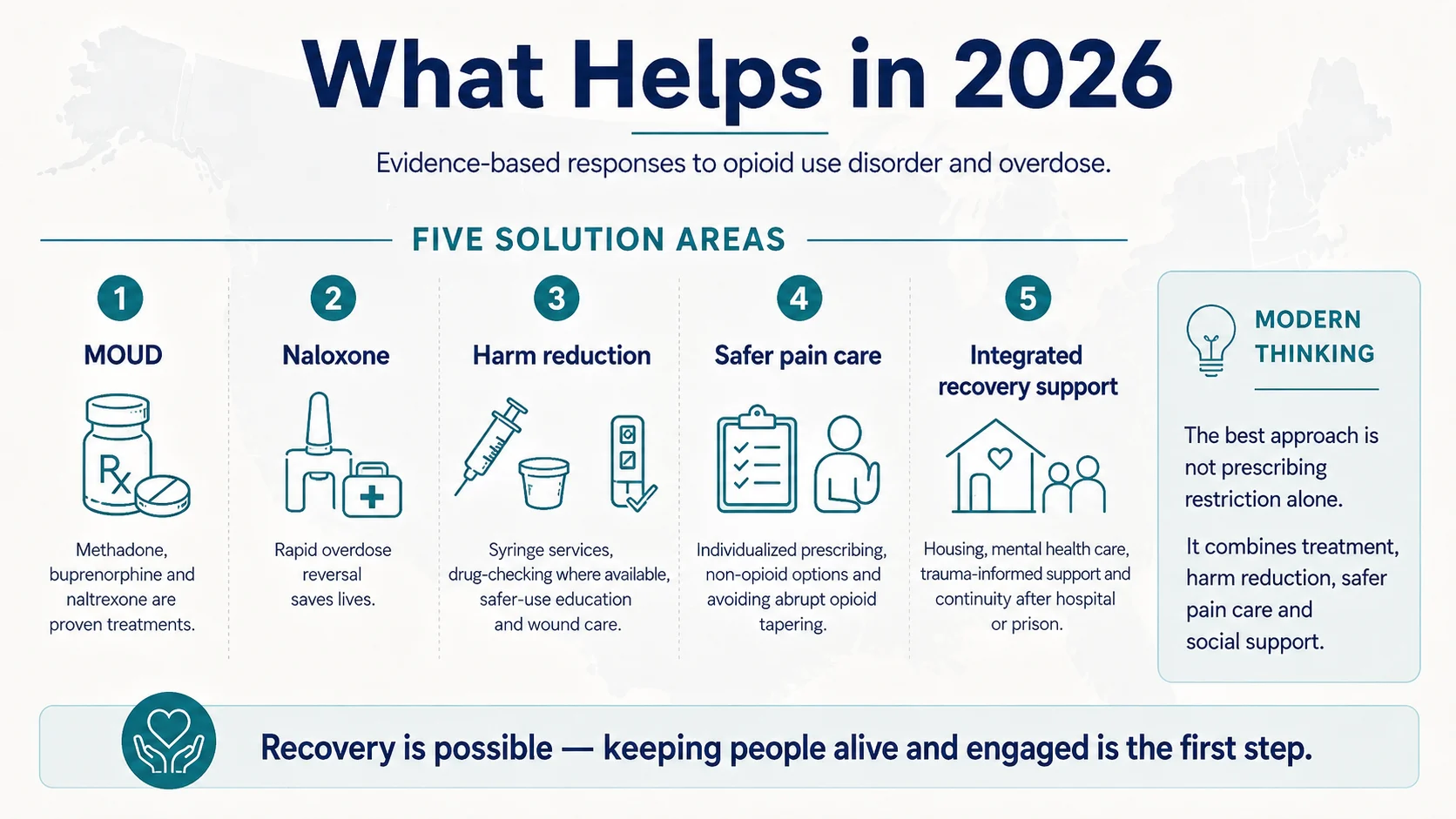
The opioid crisis began partly because medicine underestimated the risks of long-term opioid exposure. It worsened when an illicit market supplied increasingly potent substitutes. The solution is therefore not to make the opposite error and assume that opioids have no legitimate medical role or that people with OUD simply need to stop.
- The more durable framework is dual: better pain medicine and better addiction medicine. That means fewer unnecessary opioid starts, more careful monitoring, no abrupt abandonment of established pain patients, rapid access to methadone or buprenorphine for OUD, naloxone everywhere it may save a life, and social systems capable of keeping people engaged long enough to recover.
|
Bottom line |
|
America’s opioid crisis has evolved from prescription analgesics to heroin, then to fentanyl, and now toward a broader synthetic polysubstance market. The dramatic fall in deaths during 2024–2025 is genuine cause for optimism, but it is not an endpoint. The strongest 2026 approach is neither prohibition alone nor prescribing restriction alone: it is evidence-based treatment, safer pain care, harm reduction, surveillance, social support and sustained access to recovery. |
References and current sources
- CDC National Center for Health Statistics. U.S. Overdose Deaths Decrease for Third Consecutive Year in 2025. 13 May 2026. Provisional national estimates.
- Dowell D, Ragan KR, Jones CM, Baldwin GT, Chou R. CDC Clinical Practice Guideline for Prescribing Opioids for Pain — United States, 2022. MMWR Recomm Rep. 2022;71(3):1–95.
- National Academies of Sciences, Engineering, and Medicine. Pain Management and the Opioid Epidemic: Balancing Societal and Individual Benefits and Risks of Prescription Opioid Use. Washington, DC: National Academies Press; 2017.
- National Academies of Sciences, Engineering, and Medicine. Background epidemiology in Pain Management and the Opioid Epidemic. 2017.
- National Institute on Drug Abuse (NIDA). Opioids / Opioid Overdose Crisis. NIH. Current online overview.
- U.S. Drug Enforcement Administration. 2025 National Drug Threat Assessment. Washington, DC: DEA; 2025.
- CDC National Center for Health Statistics. U.S. Overdose Deaths Decrease Almost 27% in 2024. 14 May 2025.
- Substance Abuse and Mental Health Services Administration (SAMHSA). Medications for Opioid Use Disorder / TIP 63. Updated resources 2024–2025.
- SAMHSA. Waiver Elimination (MAT Act): removal of the DATA 2000 waiver requirement for buprenorphine prescribing. Current guidance.
- SAMHSA. 42 CFR Part 8 Final Rule FAQs: terminology and treatment framework for medications for opioid use disorder. 2026.
- CDC. Fentanyl-involved nonfatal overdose emergency department trends, 2020–2024. MMWR. 2025.
- CDC National Center for Health Statistics. Provisional Drug Overdose Data. Data available for analysis June 2026.